
Baldwin County is in the midst of a public-private project at the local airport, but some members of the public are highly upset with what is transpiring in their neighborhood.
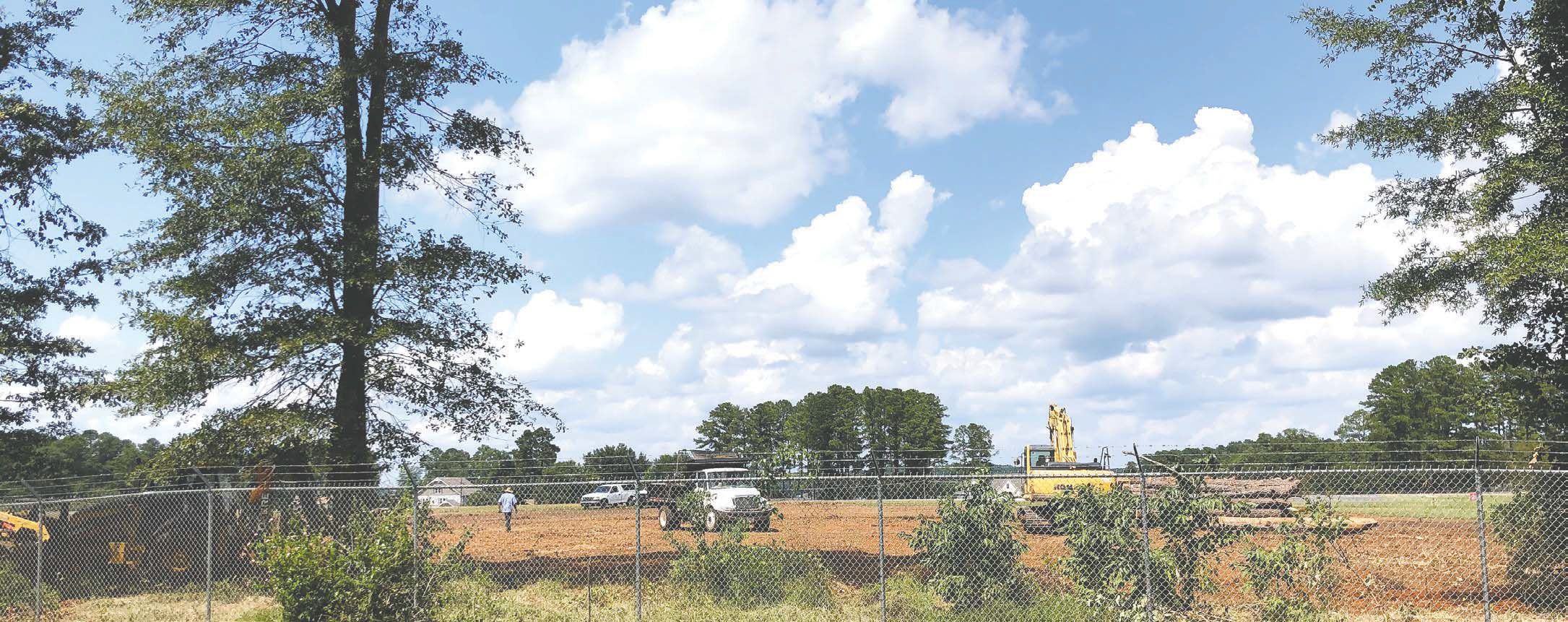
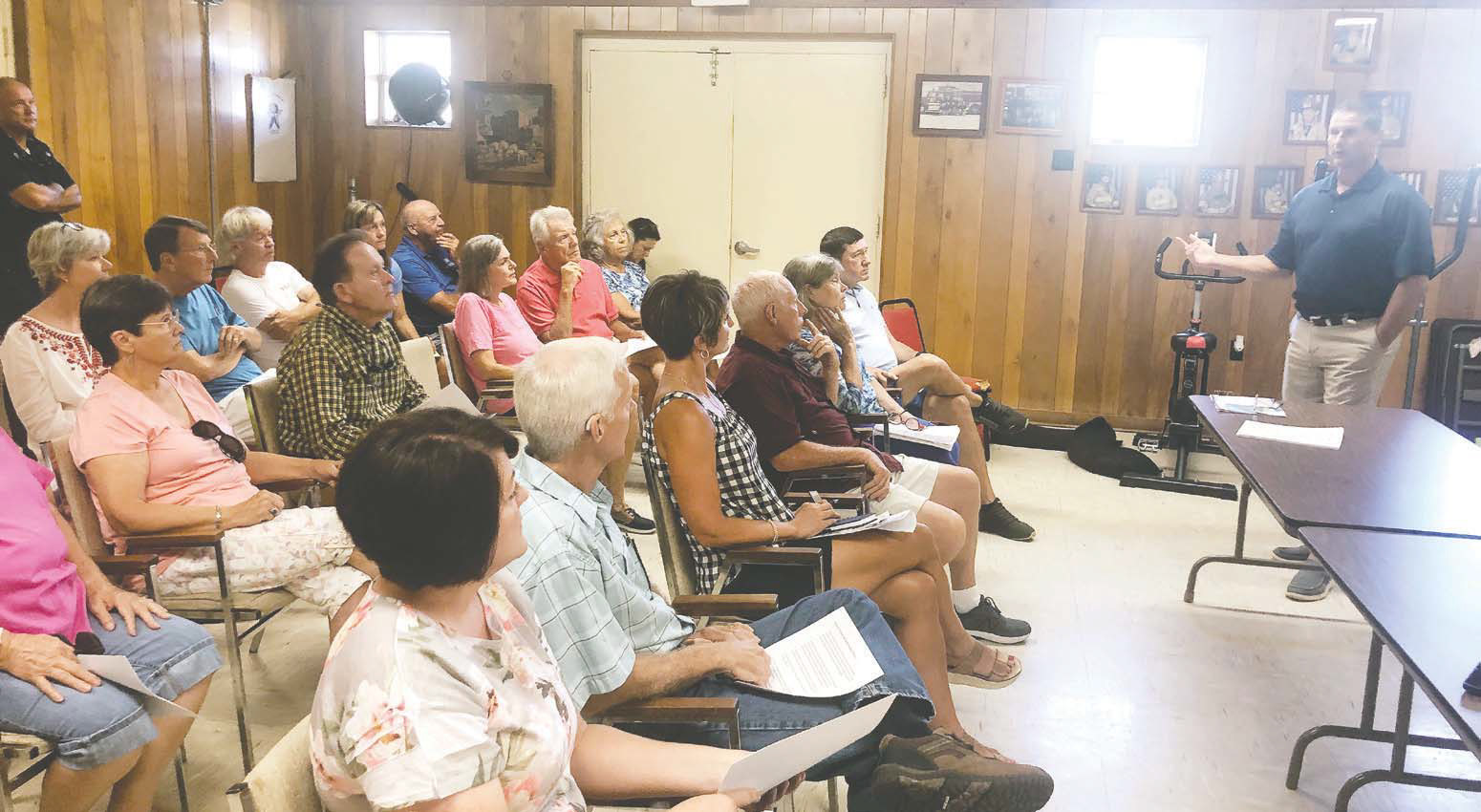
In preparation of the construction of two hangers, crews began cutting down pine trees a little over three weeks ago at the Baldwin County Regional Airport, and that sparked an immediate outcry from nearby residents. Complaints led to a meeting at the airport Aug. 21. County manager Carlos Tobar and Jim Wolfgang from the airport advisory committee met with a group of angry homeowners.
That discussion apparently produced no positive results, and approximately 25 residents met last Friday afternoon to discuss possible courses of action.
The dispute is a result of a federal grant the county was awarded, payable in five yearly installments of $295,000. The county has thus far received nearly $600,000, the cost of its share of the airport project work.
The money is being used for necessary site work for two 100’x90’ hangers: earthwork, concrete aprons in front of the hangers, and connections to the taxiway.
A private entity will pay for the concrete pads and hangers and will own the buildings. That company will lease the property from the county at seven cents per square foot of the size of the buildings and will pay ad valorem taxes on the hangers and any airplanes housed there, Tobar said.
The county manager said one of the hangers will be 30 feet in height and capable of housing a plane similar to a Gulfstream 150. The other will be 20 feet high and possibly sufficient for two smaller planes, depending on size.
David Ballew has lived on Lakeshore Circle, across from the area where the hangers will be built, for 10 years.
“When we built our house, we were left with the impression the trees were going to be left there,” he said this past Tuesday. “There were building hangers at the opposite end of the runway. Then the new project surprised everyone. They came in and started clearing the trees and never told anyone anything about doing this.”
The homeowner referred to the meeting at the airport and indicated that Tobar said the project was put out in 2019 to the neighbors.
“No neighbors at this meeting were aware of any letter that came out or any type notice that they were going to build these hangers,” Ballew said.
Ballew said the proposed hangers will present serious concerns for nearby residents.
“These jets have to warm up for 30 minutes before they are able to take off,” he stated. “There is no way they are going to be able to run those jets for 30 minutes without blowing the exhaust into someone’s property in front of their house.”
Rich Bilz lives directly across the street from the site. He confirmed that a petition has been drawn up and is being circulated in opposition to the hangers.
It cites noise from frequent takeoffs and landings, toxic exposure by proximity to running jet engines, safety concerns with additional traffic in and out of a new entrance, and the environmental impact of the removal of “the natural tree barrier which blocks fumes and noise from homes.”
He said that less than 12 hours after the tree cutting began, he and his wife, Casey, could smell fumes.
“I asked Casey if she could smell anything, and she said kerosene. I told her that was jet fuel. And, that is before the hangers are here, before they start warming up for 30 minutes.”
Bilz said the trees taken out were as tall as 80 feet, and there was underbrush present that also served as a buffer.
“They’re not going to be able to replace this buffer 60 or 80 feet tall. The first thing they said was ‘We had to get FAA clearance on the roof.’ They admitted to us they were going to have to reduce the height of the hanger to comply with FAA regulations," Bilz stated.
He went on to say if the roof of the hanger can be only 30 feet, “They’re not going to let us put back 60-foot trees.”
Tobar acknowledged that he is not aware of any individual communications with nearby residents but said there was ample information available.
He said there was a news story in 2016 about airport expansion before he was employed here. Development of the Airport Layout Plan was started in 2017, and he attended a meeting his first month on the job in 2018, which was attended by “dozens of people” who were shown the proposed plan for the airport expansion.
The project was also part of the Baldwin County Comprehensive Planning Process, one of the four items under economic development, Tobar said. Numerous public hearings on the plan were held, and it was on the county’s website, including a link to the airport.
“We have been extremely transparent about what we are trying to do,” Tobar said, adding that the commissioners adopted the Airport Advisory Committee’s recommendation to approve the layout plan at a June 5, 2018, public meeting.
Tobar also admitted he is opposed to pine trees on the airport property.
“I’ve been on record since the very first meeting back in 2018 that I hate these longleaf pines right by the right-of-way,” he said, noting other areas of the county have had problems with those trees.
He said, however, replanting will be done.
“We’re going to go back and plant something that makes sense, something that’s not going to fall over, that has a stronger root system. “I can tell you no matter what we were going to do,” Tobar went on, “there was going to be a vegetative buffer. I think there was a difference of opinion on what type of vegetative buffer that was going to be. You’ve got to wait for these trees to grow up before it blocks your view. But in the long run, everyone benefits from having the right type of trees out there.”
Bellaw had a different view.
“The trees have been here for over 75 years and do a great job of buffing the noise, smell, and pollution from the airport,” he countered. “Now the taxpayers have to pay for replacing them with much smaller trees that will take years to mature.”
District 4 Commissioner Henry Craig, who halted the cutting of the trees, expressed a somewhat different viewpoint than the county manager but did agree with Tobar on the outlook for the future.
“It is unfortunate that so many trees came down. I would have preferred fewer trees (being removed),” he said. “But, going forward, we will be much more sensitive to the trees remaining. Other than where the entrance is to the future hanger, there will be no more trees to come down. There may be one or two to facilitate the entrance, but there will be no more unless it is to facilitate the safety of the building being constructed.”
The commissioner believes the future buffers will be effective and more attractive.
“Rather than the longleaf pines and scrubby oaks, there will be crepe myrtles and some sort of fir trees that grow fast, and we will purchase them already six feet tall or so,” he said.
Craig acknowledges there is other space at the airport for hangers but says plans are in the works there as well.
“There are potentially other areas in the airport. As I understand it, there are already plans for those areas. Where they are building the new hangers, at the east end of the airport, has been a part of the airport plan, Capital Improvement Plan, since 2017-18.”
Craig also weighed in on the notice issue.
“I think the county does our business in a transparent way,” he said. “But it is only transparent for those who look. All of the decisions that were made at the airport were made in public meetings. It’s been a part of the Airport Plan, that specific area, since 2017-18.”
Tobar confirmed that there are already plans for other areas of the airport, but cost and funding are at issue.
“All the other land requires extensive work,” he said. “We have applied for grants to do that, but we are waiting to hear next year. The earthwork required in other parts is in excess of $6 million.”
Craig and Bilz both confirmed that several homeowners are to meet with the commissioner this Thursday to discuss the matter.