
Georgia College & State University (GCSU) hosted the reception for the Rowing Forward Looking Back exhibit on Feb. 1 with an online talk by the artist Hannah Israel.
Israel is from Columbus and is a professor of art and the gallery director at Columbus State University. She received her Master of Fine Arts in Sculpture at the University of Illinois in Urbana-Champaign. Her work has been exhibited in numerous galleries and found a short-term home in the Leland Gallery in GCSU's Ennis Hall.
“The essence of my work involves charting the interconnectedness of our existence,” wrote Israel in her biography. “I convey movements from my life, emphasizing the delicate nature of language and predictable aspects of our experiences influenced by the world’s temperament.”
Her work focuses on “extracting beauty from tangible materials through drawing and sculpture.” During her artist talk, Israel explains that the title of the exhibit is an analogy of rowing.
“Most of the time when you row, you face backward because our body anatomy makes it easier to pull the oars through the water rather than push them. It makes us feel like it's the natural way of going through that process,” said Israel. “I love the notion that when we are rowing forward, we are facing backward but then we have to look and see what is behind us. It is a connection of trust and figuring out what is coming.”
Israel said another meaning of the title references attendees of the gallery looking over each other’s shoulders. While someone is looking forward, another is looking over their back and sharing an internal conversation of the piece they are viewing.
“A quiet conversation between bodies and how they, as the audience, participate in creating the meaning of the piece,” said Israel.
During her talk, Israel talked over 25 attendees through her process of creation and what her studio looks like. She spoke on her inspirations of being influenced by dynamics and how people change over time.
“It's a paradigm of creating possibilities of questioning in what they’re making,” said Israel as she demonstrated her process of creation using carbon prints. In her biography she further explains this statement writing, “The paradigm presented in the exhibition’s world constructs a realm of physical impossibilities, prompting questions about our presence and behaviors.”
Closing her artist talk, Israel highlighted a few pieces in the gallery and spoke briefly about their meanings and inspirations.
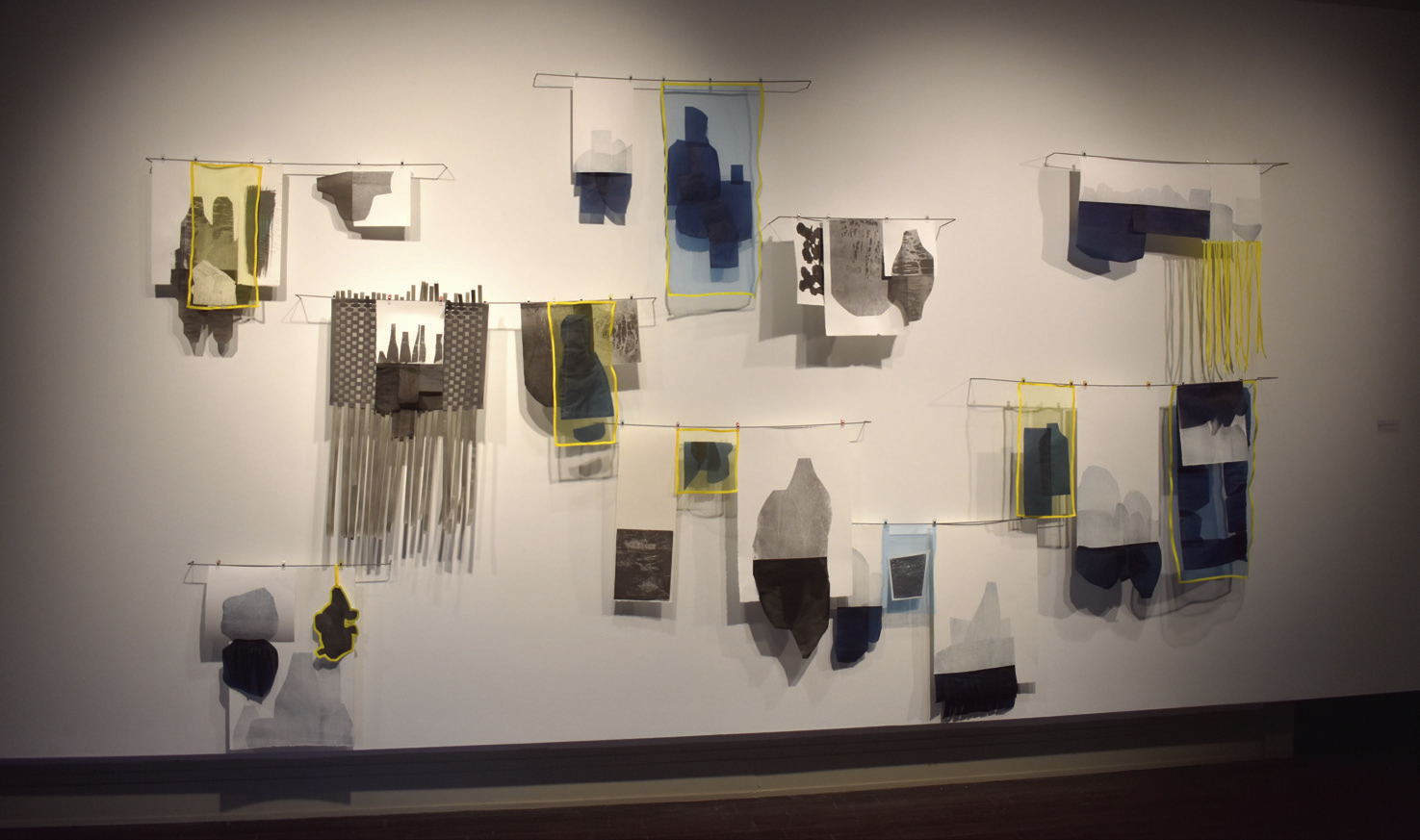
Seeing and Being Seen II is an arrangement of drawings and was created using one of her favorite processes in the studio. A “kind of domestic process” that uses heat and leftover carbon paper to create more art.
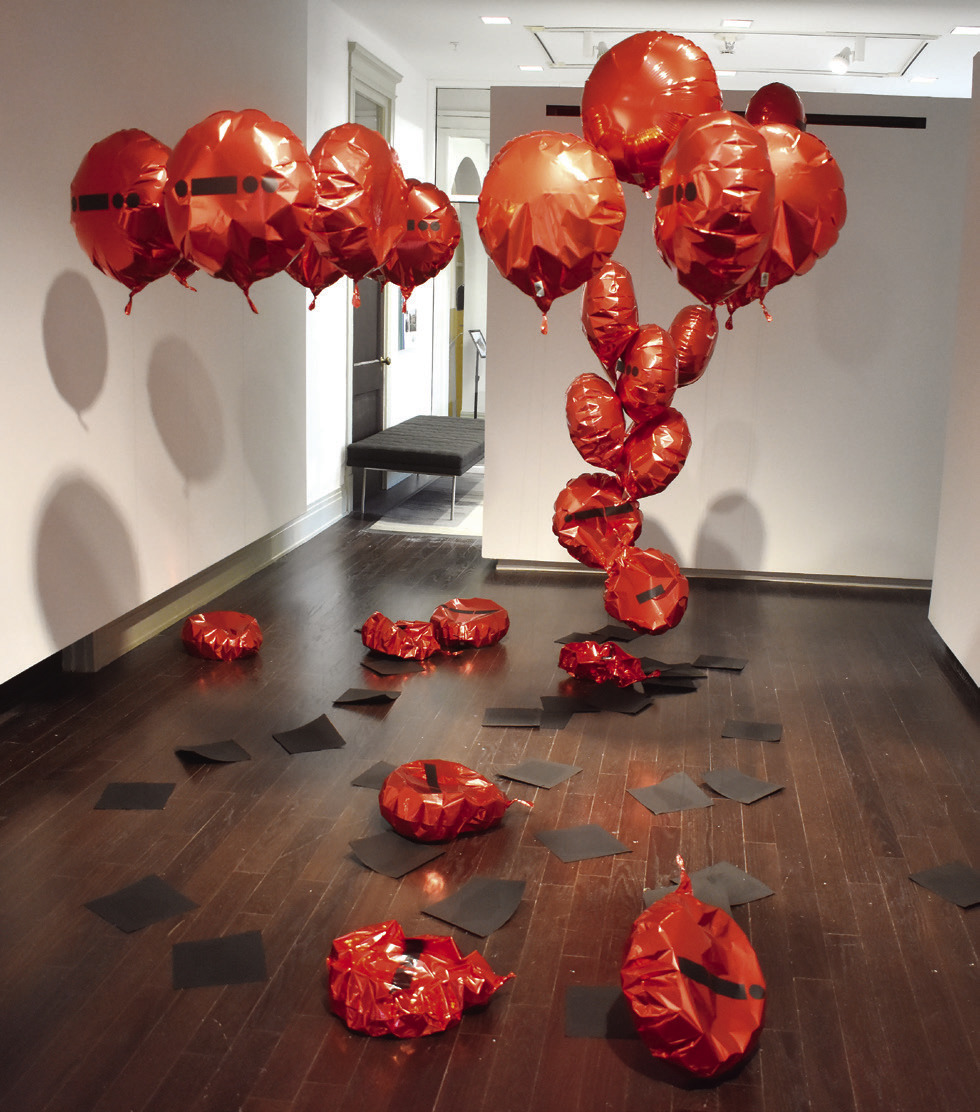
America II is a recreation of a piece she made in 2015 that spoke on how she felt about the state of the world. The red balloons are held down by carbon prints of how Israel remembers what each state looks like from memory, rather than referencing a map.
Each balloon is printed with Morse code on it that ultimately spells out “WTF.” This is the third time she has exhibited this piece.
“The power of language is important to convey,” said Israel when reminiscing on her struggles to communicate when coming to America and the effects of assimilation, which inspired the piece.
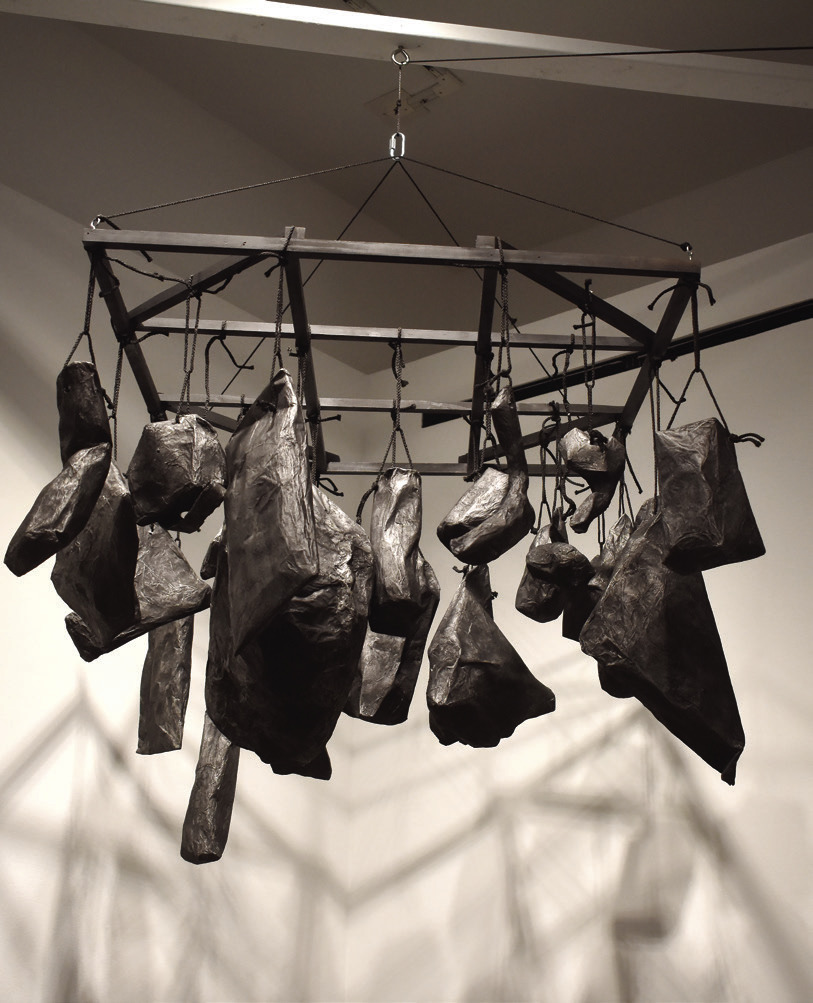
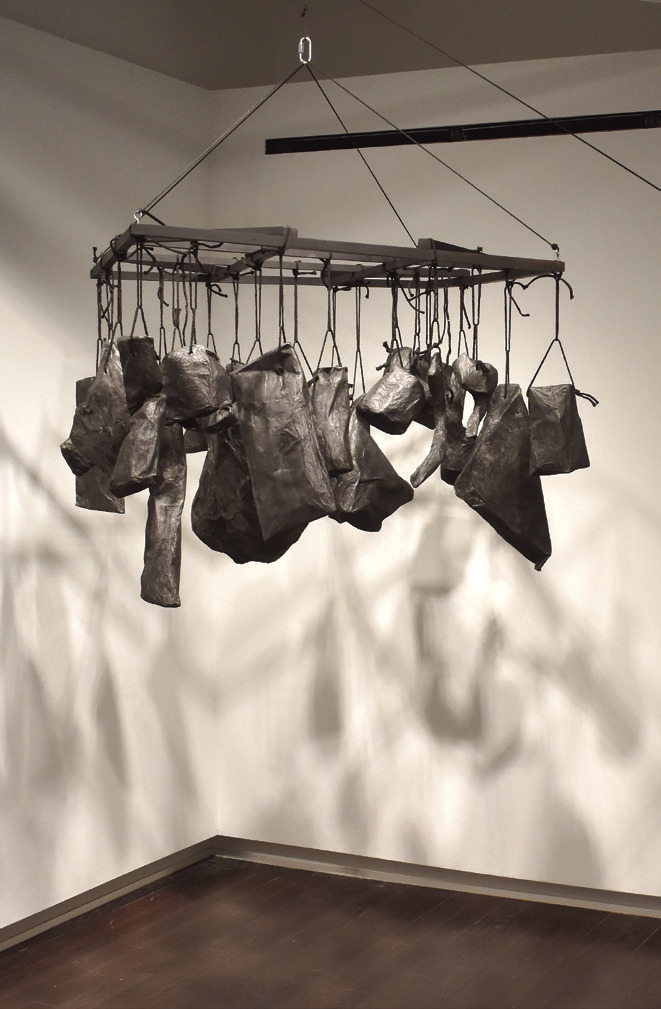
Pabitin or Hang Up is a piece based on a game that Israel used to play in the Philippines, where they would tie up objects and then jump to retrieve them from the strings.
For the piece, the objects are made from graphite on paper and are hung up high for attendees to look up and be intrigued to take.
According to Israel, the piece speaks on the vulnerability in the want of a child to grab things out of reach and how humans, as a whole, view objects of importance.
The Feast was made using carbon prints on paper and shows silhouettes based on objects in her kitchen. It is a seven-part series that speaks on Israel’s interest in architecture and the relationships between architectural structures.
“ Feast is a collection of drawings of these forms and shapes that are on the table. That’s a piece that relies on the relationship of architectural arrangement,” said Israel. “It’s important that these objects that surround me are a part of the language that I use in the pieces that I make.”
Rowing Forward Looking Back was exhibited at Leland Gallery until Feb. 6. Using a process that crafts art using actions such as sorting, shifting, pasting, gathering, and more with materials like fabric, ink, pigment, graphite, and technology, Israel hopes to “suggest new meanings or languages that abstract everyday information.”
While the story may not be initially clear, abstract thinking can lead any viewer to find the deeper meaning in the shapes, language, and architecture that surround them each day.