
Milledgeville’s engineering firm updated the mayor and city council Tuesday night on roundabout projects being studied, but so far, no firm plans are in place.
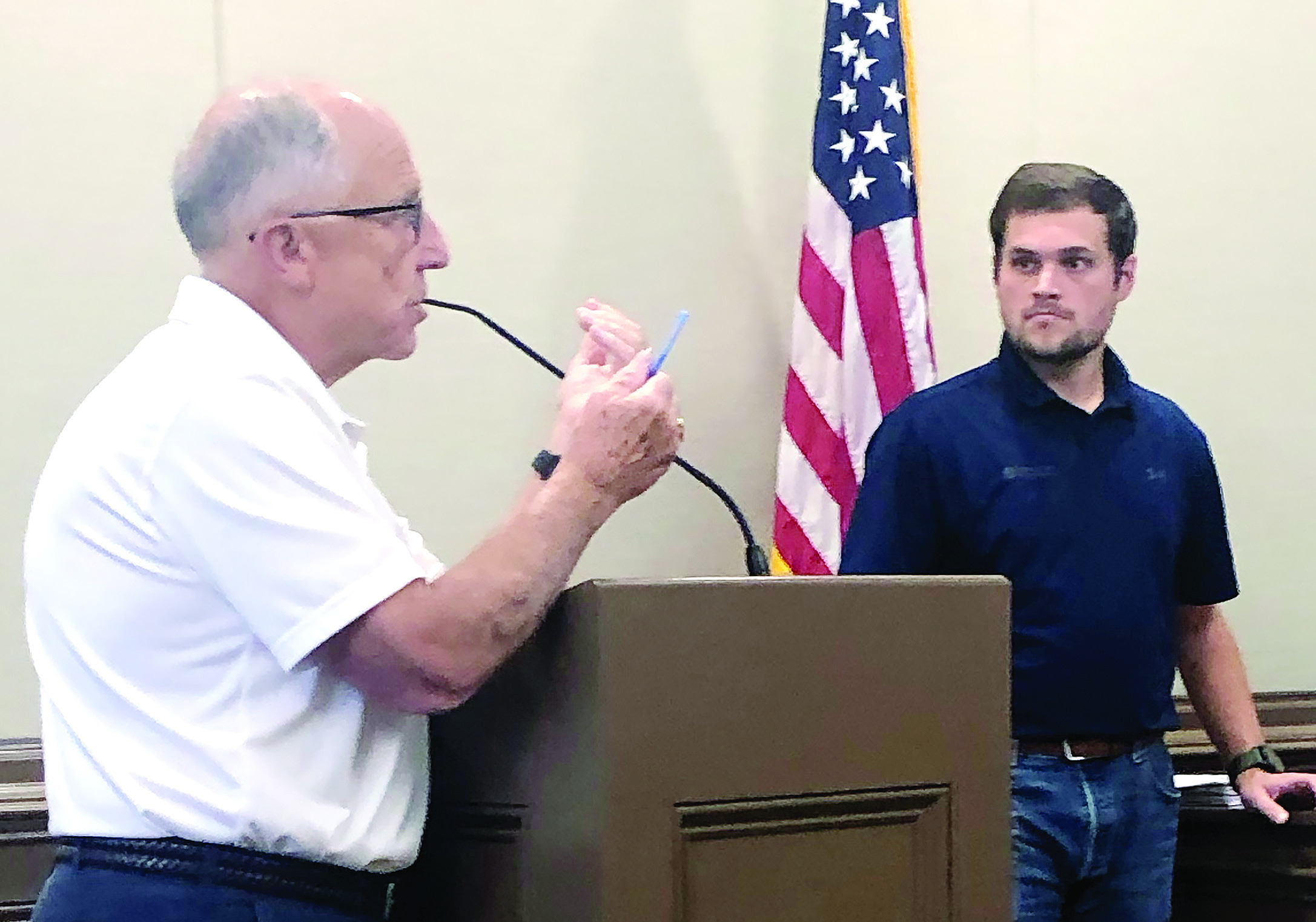
Paul Simonton and Corey Johnson of Simonton Engineering briefed city officials at their regular Tuesday meeting on the firm’s progress thus far on the feasibility of roundabouts at North Jefferson and Dunlap Streets and North Jefferson Street and Log Cabin/Sinclair Dam Road.
The two engineers first discussed North Jefferson and Dunlap but said not enough data was available so far to give a meaningful report regarding the Log Cabin/Sinclair intersection with North Jefferson. An accurate traffic count at that intersection was a key holdup.
“The first traffic count we got was when school was not in,” Simonton said. “We ordered a second traffic count on that and just got it back.” Johnson added, however, that he found reports on only two accidents there that caused injuries.
“We will go through the same analysis on this one as the other and come back with a report,” Simonton said.
Simonton referenced the traffic count when he began his report on the North Jefferson/ Dunlap intersection and said once that data is collected, it will be put on a spreadsheet.
“The next thing we do is build kind of a model of the intersection so that we can evaluate the performance of the intersection,” he explained.
Then the intersection will be evaluated based on “warrants” established by Georgia Department of Transportation (GDOT) standards, Simonton said.
The initial warrants are traffic counts on both roadways, during the eight peak hours, then the peak four hours, and, finally, the peak one hour.
Simonton noted there is not a school or traffic control device present and said another possible warrant is foot traffic; however, “there’s really not a lot of pedestrians going on there, at Dunlap and North Jefferson,” he added.
“Crash experience … was the most important evaluation factor for this intersection,” Simonton continued. “After reviewing the data, basically the only warrant that this intersection met was the crash experience.”
The engineering consultant then concluded that based on that warrant in conjunction with other GDOT factors, “This intersection is a really good candidate for improvements.”
Johnson followed Simonton with an animated presentation on the various alternatives, showing how traffic was affected by delays at the intersection.
“When those delays get to two or three minutes, you know your intersection has failed,” he stated.
Using an animated traffic program, Johnson went through each of the four alternatives for the intersection: remaining as is, as an all-stop intersection, with a traffic control device, or as a roundabout.
He first discussed the option of making no improvements to the intersection, and the computer program showed the vehicles backing up on Dunlap Road for the left turn.
“Everybody’s starting to get anxious now,” he said of those drivers and added that the delays eliminated that alternative.
Johnson then showed the traffic flow at an all-stop intersection, with the backup on Dunlap similar to what is there now. Safety also was cited as a concern.
“That decreases safety because everybody is stopping,” Johnson pointed out. Council member Steve Chambers echoed that concern, pointing out that drivers sometimes don’t know when it’s time to proceed.
Next, Johnson showed the traffic signal alternative, recognizing it provides a relatively high level of service in the mornings and evenings. However, he also called it a “second-rated alternative,” due to crashes, project cost levels, and sometimes ineffective delays.
The roundabout was shown as the final alternative, with the traffic flow shown on the animated program.
“The big thing is, it keeps traffic moving,” Johnson pointed out. He said the proposal would be for a single-lane roundabout, with a small amount of right-of-way acquisition required.
The engineers discussed the possible cost of a roundabout versus a traffic signal – both for installation and maintenance – but provided no specific numbers.
When asked if there were any questions, Chambers responded, “With the continued growth northwards, whether it be north Baldwin or South Putnam, these types of solutions are going to have to be looked at, and the sooner we look at them, the less costly they are going to be.”
No date was set for further updates on the two projects.