
Many neighborhood residents who successfully fought the proposed east apron hanger project at the Baldwin County Regional Airport are now trying to stop the construction of a multi-purpose path around the aviation facility and adjacent to nearby roadways.
The trail, now referred to as a shared-use path by the Georgia Department of Transportation (GDOT), if completed would be 3.6 miles long and run from Airport Road around the airport and in front of homes on Newport Road before turning onto Lakeport Road and back to its starting point.
Numerous individuals have addressed the commissioners in recent meetings and have garnered over 150 signatures of residents in nearby areas in an attempt to convince the board not to go forth with the path.
Carol Ballew was among the group that sought signatures for the petition.
“There were several of us who went door to door,” she said. “We stuck to the neighborhood: Lakeshore Circle, Lakeshore Court, Newport, Airport Road, Island View, and slightly down E. Lakeview. There were no signatures collected from any other area. It was around 95 percent of the doors opened, agreed to sign.”
Marlene Lovejo, who lives on Newport Road, was one of the speakers at the Dec. 5 meeting, and she focused on the refusal of the Federal Aviation Administration (FAA) to grant a release for any construction on the land in the Runway Protection Zone (RPZ).
That refusal led the county to alter the path alignment where it ends at one point at the end of the runway on the east side of the airport, then resumes in about 300 feet, when it is out of the RPZ.
Lovejoy and her husband, Ben, also submitted a summary of issues they have with the proposed trail, including lower property values, maintenance of the path, disruption of a neighborhood street, safety concerns due to joggers, walkers, or cyclists being in a driveway, and “government takeover of our property.”
Rich Bilz, a Lakeshore Circle resident, also spoke at the Dec. 5 meeting and used a cost-analysis approach. He noted the Board of Commissioners had approved resurfacing of Log Cabin Road for $200,000 per mile.
“It’s our opinion that the proposed path will be used by only a few but inconvenienced by many.”
Bilz added that dedicated cyclists and joggers are going to use the road system in the neighborhood rather than stay on the path.
“They are going to travel the entire seven miles of curving, winding roads through the shade trees and along the scenic lake. They are not going to keep going around in a circle.”`
One of the prevalent issues – cost – was addressed by Ben Lovejoy.
“My main concern with Mr. Tobar is that he has never offered a projected total cost on this pathway after four years in the planning,” Lovejoy stated in a text message. “In my opinion, it will cost millions of dollars to build, as well as maintain it. Bikers will not use it, and most people walk in their own neighborhoods.”
Tobar acknowledged that the original $1.1 million estimate is not accurate now, and he said it was his belief a realistic number could not be determined until the final design and preliminary engineering was complete.
Lovejoy also cited the cost of relocation of utility poles, the location of water and cable lines, and the FAA’s position that the path is incompatible with land use with the airport. Tobar, however, has said engineers have informed him there will be few, if any poles that need to be relocated.
If the project goes forward, it appears the path on Newport Road will be only a sidewalk, removing the need for water line relocation, though, as Tobar pointed out, there will be the expense of curb and gutter to replace the ditches. In his opinion, that will reduce the distance of potential impact on the homeowners’ yards.
Ballew was among the speakers at the Dec. 21 commissioners’ meeting, and she questioned the validity of the county’s first survey in 2020.
The outcome of that sampling was 67 respondents, 38 in favor, 21 opposed, four neutral, with four questionable. Ballew talked about those who had moved since then, new homeowners now opposed, and some who changed their minds since the initial survey. Her final count was 33-33.
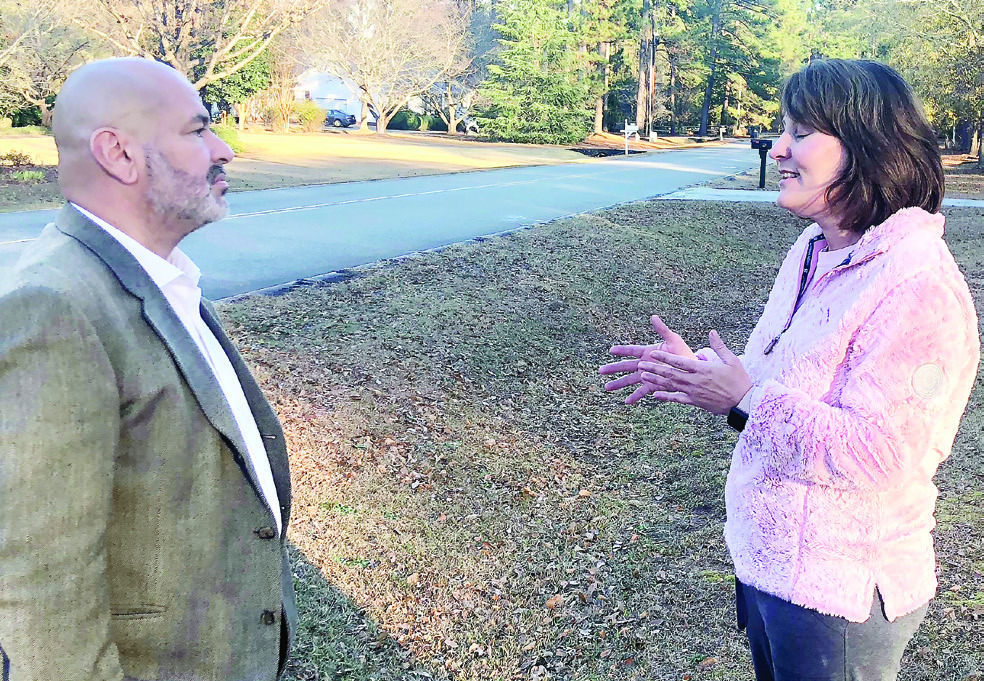
Newport Road resident Linda Colwell was the one discussing the path with Tobar at her home on Newport Road on Dec. 21 when the subject of a sidewalk came up. Tobar subsequently obtained GDOT approval for the change.
“I am not in favor of the project,” she answered when questioned about the revised plan this past Wednesday morning. “If it were passed, obviously a five-foot sidewalk is less intrusive than a 12-foot path.”
One impact that was mentioned often in the airport hanger debate was a reduction in property values. Local real estate Susan Lebendiger, who lives on Lakeshore Circle, said the proposed multi-purpose path development is unlike many that prove popular.
“Reduced value problems occur in odd situations like ours,” she said. “I believe the folks on Newport will suffer a reduction in value due to reduced privacy and increased disturbance.”
The real estate agent pointed to Peachtree City and the Atlanta beltline as two examples of positive results.
“They connect to opportunities, not just for exercise and recreation, but also shopping and restaurants. Many folks use them for work commutes as well.”
Lebendiger elaborated on numerous other issues and cited the city of Milton, where “a lot of voices were heard and a lot of analysis was undertaken based on that feedback.
“Here, there is no proper vetting of location, need, or purpose,” she said before asking, “Is this merely the airport folks again seeking gains for the airport by building/maintaining a parking lot for the airport?”
Tobar said that is not the case.
“The budget does not contain any money for a parking lot,” he said. “There is no money in this grant for a parking lot.”
Lakeshore Circle resident Joan Crumpler, who spoke at several county commissioner meetings regarding the airport hanger project, submitted a statement as the unofficial spokesperson for Newport Road residents. She does not see the need for a shared-use path or even a sidewalk.
“Because this entire area has no through traffic and already low-speed limits and low vehicle use, it has peacefully and compatibly coexisted with bike riders and walkers for many years without any crash or incident reports,” she stated, leading her to believe the only reason for the path, or on Newport Road, the sidewalk, is increased use.
“However,” she continued, “increased use naturally increases traffic and safety concerns…The Newport Road neighbors have no choice but to see and experience trail users daily. The proposed sidewalk is essentially in their front yards.”
Crumpler echoed Lebendiger’s concerns of reduced property values and cited a 2021 study, which, she concludes, “stresses the importance and need to work with adjacent homeowners before any money is spent.” Crumpler said that the study may be found at krex.k-state.edu, with Caleb Whitehouse as the author.
Whitehouse wrote that the questions his project was seeking to answer were: ‘How can planners identify landowner preferences?’ and ‘How can these preferences be incorporated into the least-cost path analysis?’
Those are two questions that were not asked here, Crumpler said.