
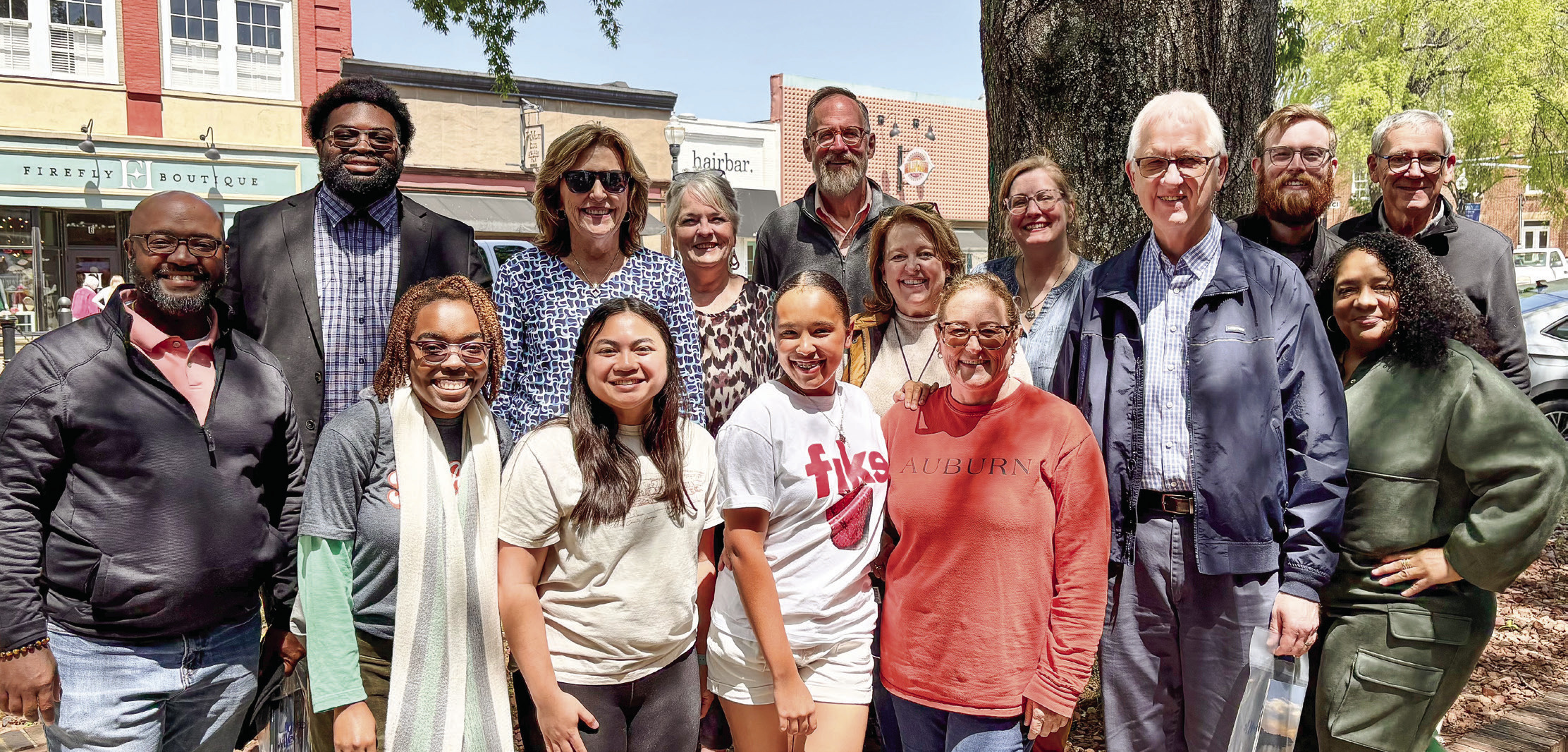
During the spring semester, Dr. Greg DeLoach and his class “Dementia, Disabilities and Differences” of Mercer University’s McAfee School of Theology in Atlanta visited Milledgeville’s Central State Hospital Museum.
Jessica Whitehead is a local photographer and author who began teaching the history of the largest asylum in the United States through her exhibit Seeking Asylum. The exhibit that captured the campus’ present decay transformed into a small museum located at the Central State Hospital Depot through a partnership with Georgia’s Old Capital Heritage Center.
Most recently, Whitehead debuted her photography novel Seeking Asylum that blends the history of the museum and her photography together in a handheld keepsake.
“Prior to starting the project that evolved into Seeking Asylum, I worked in mental health for 14. I have worked as the assistant to Judge Terry N. Massey for seven years, and prior to that I was a program coordinator for the juvenile court Judge Philip B. Spivey (retired) for four years,” said Whitehead. “I became acquainted with Dr. DeLoach through connections with a coworker, and he was interested in offering his class a thorough history of Central State Hospital and a visual perspective.”
Whitehead led a tour of the museum, a drivearound tour, and an open discussion on mental health with the class of 12 students. Using her own experience working in mental health and discussing her own challenges related to mental illness, Whitehead offered a retrospective of not only the past of mental health but also what present-day care and treatment looks like.
“I spoke about the history of each building, the size of the campus, the types of patients served, my motivations, and the importance of mental care advocacy,” said Whitehead. “The class has a focus on memory. I have a dissociative disorder that impacts my memory, so I was able to speak with them intimately about that.
“I think when you can have hands-on experience like this, you can truly apply your textbook information to real life and take a moment to step back and learn more about the individuals,” added Whitehead. “It’s easy to say, ‘the people at the hospital,’ but when you hear the personal stories, it makes the book learning more impactful because it becomes intimate and offers new perspectives.”
DeLoach designed the 16-week course and stated that it teaches about “serving cognitive impairments,” with a focus on dementia. The students who took the course are most commonly preparing for parish or congressional work or planning to be involved with nonprofit organizations.
“The idea behind the graduate course was to help students prepare for these careers. Dementia and mental illness are strongly on the rise in so many categories, so I wanted to offer a class to allow students to think about what it means to serve when mental health, illness, and intellectual/ developmental disability challenges are present,” said Deloach.
Deloach grew up in Eatonton and had strong family ties to Baldwin County. Knowing about Central State Hospital historically, DeLoach came across the novel Administrations of Lunacy by Mab Seagrest while reviewing possible texts and criteria for the course.
“While I ultimately did not use the novel because it did not tie in well enough to our syllabus, it led me to think about the time period when people struggled to know what to do with loved ones with cognitive impairments, mental illness, or intellectual/developmental disabilities,' said DeLoach. “It would be a good historical field trip for the students to not only see what occurred in our state but throughout the country and see the transformation over generations of how people learned to address the societal concerns of mental health challenges.”
According to DeLoach, this was a first-time experience for the majority of the students, which gave them a deeper perspective to the “surreal” quality of the campus.
“It was an incredibly impactful and meaningful tour,” said DeLoach. “It’s important to have these healthy conversations. Jessica Whitehead did a wonderful job empathizing with the approach of how many people did the best they could with the limited resources of the time. We had deep conversations on how each generation experienced and responded to any kind of cognitive impairment and how we value or disvalue that.”
DeLoach also stated that the tour aimed to give courage to his students to share their own stories. Identifying and empathizing with mental health is critical in learning how to stop outsourcing a “problem” and rather learn how “healthy communities cultivate healthy responses,” according to DeLoach.
Deloach plans for future participants of his course to tour the museum as student feedback was a 'strong affirmation” that the new course should be offered regularly and that the field trip is a necessity to the experience. The course is offered every other year.