
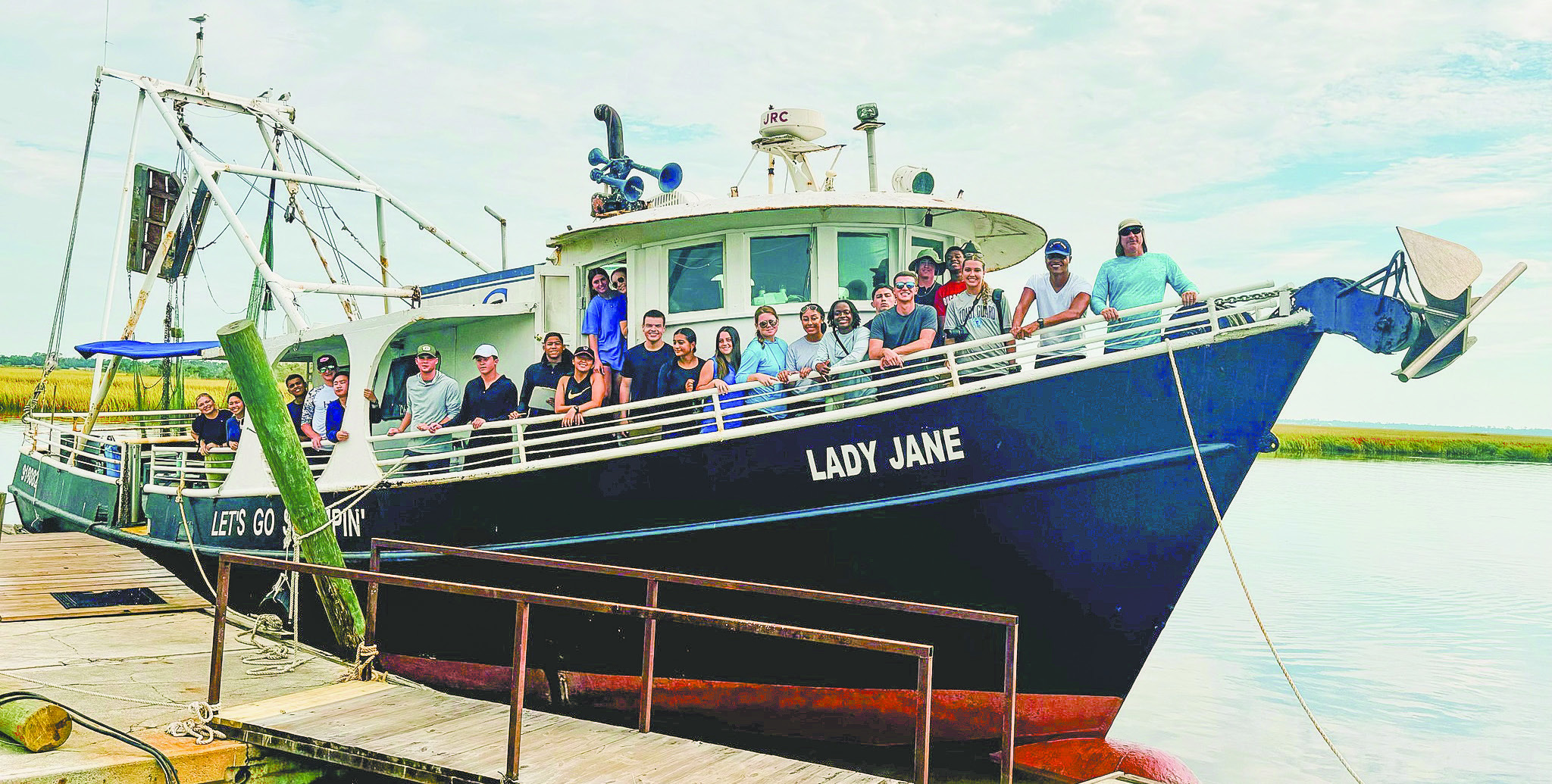
Georgia Military College’s Marine Biology class took a field trip to Jekyll Island this month to gain professional experience in the field of marine biology and engage in research.
“The Jekyll Island field trip was designed to combine the concepts the students have learned in lecture and lab into a cohesive experiential learning experience,” said Mark Fairbrass, Health & Natural Science department chair. “Jekyll Island has a nice Wet Lab that students were able to use for wet activities and marine research. It was the perfect working space to apply what they learned in the classroom.”
According to Faribass, the primary goal of the experiential learning was to allow students to gain professional work experience, meet people in the field, and learn more about the economic impact and importance from a working source.
Students spent time on a commercial trawler where they got to see in practice the commercial fishing gear they have learned about. They also saw firsthand how “bycatch reduction devices and turtle excluder devices work, and how these mandated devices reduce the death rates of non-target organisms by commercial fishing operations,” wrote Fairbrass in his summary of the trip.
After the boat pulled a trawl, the collected organisms were sorted by the students. This activity offered them a practical understanding of the types of animals living in Georgia waters. They were also able to observe the ratio of bycatch to target species capture rates in typical trawling operations, according to the report.
“We discussed the economic and environmental hardships faced by Georgia's commercial fishing industry. Unless the students grew up around the industry, they may not understand, so these field trips allow students to speak directly to those impacted by these hardships and those actively working in them,” said Fairbrass. “Nothing is more impactful than learning directly from the source.”
In addition to learning about commercial fishing, students conducted the type of work completed by state and federal marine biologists. According to the report, students took marine chemistry measurements and determined how much of the water column could support a positive rate of photosynthesis allowing them to see the real-world impact of what they learned about in class.
“To broaden the student's understanding of the work conducted by state and federal marine biologists, the students then analyze the populations and communities of animals found around Jekyll Island,” states the report.
Students calculated the size of a single population of crabs in one section of the salt marsh then learned how to measure and describe the community biodiversity while seine netting in different locations around Jekyll Island. Students worked to identify and classify the species they found and produced biodiversity indices to describe the amount of species diversity in the different communities sampled.
Students also studied plankton biodiversity, microscopic free-floating organisms, and identified the types of organisms found in that plankton sample and if they were adult or juvenile organisms, according to the report.
“This activity gives the students an appreciation for the number of zooplankton found in our coastal waters, and how important they are to the food chains that keep our coastal ecosystems healthy,” wrote Fairbrass.
Finally, students learned skills used by marine biologists to assess fish stocks. According to the report, “fish contain ear bones called otoliths that can be sectioned to reveal rings like the rings seen in the trunk of a tree.” By reading the rings, students can calculate the age of the fish from which the bones were collected and put it together with the length of the fish to calculate a simple growth rate. The students determined at what age, or length, the fish showed maximum growth rates.
“Biology is important in all specifics and it’s important to give students a well-rounded perspective at a career or field of study beyond the classroom. At Georgia Military College, we focus on career-minded field trips and experiences so students may apply their knowledge to use in the field,” said Fairbrass. “The goal is to encourage our students to pursue careers beyond the classroom.”