
The Baldwin County Board of Commissioners conducted two public hearings this past Tuesday, and a third one is scheduled for the end of the month to comply with state law.
Baldwin County underwent what Chief Tax Appraiser Wade Williams termed “a total property revaluation” this year, and that reassessment process triggers certain choices for the board.
Assistant County Manager Dawn Hudson explained for tax purposes, property must be assessed at 40 percent of fair market value. She said a tax mill equals $1 for every $1,000 of assessed value for a property.
She said the board must determine what amount of money would be realized from last year’s digest without any revaluation, and that would constitute the rollback rate. For 2024, it is 8.54 mills, Hudson said.
“If the county does not take the rollback, it must advertise this as a tax increase, even if the county does not increase the tax rate,” Hudson said. She explained that any tax increase by local governments also requires notice in the legal organ of the county and a minimum of three public hearings.
Hudson also said the county should not take the rollback.
“For 2024, the recommendation for the proposed millage rate is for it to remain the same as 2023, 10.02 (mills),” she declared.
Hudson observed the overall tax increase of the tax digest this year is 17.28 percent, so she said for a home valued at $155,000 – the average in Baldwin County – at 10.02 mills the increase would be approximately $110 in taxes.
Hudson also pointed out property taxes account for approximately 60 percent of the county’s revenue.
“LOST (Local Option Sales Tax) taxes bring in about 21 percent,” she explained. “So, between the two, property tax and sales tax, they bring in 81 percent of the revenue. The balance comes from several other sources, primarily fines and forfeitures, and charges for services.”
Hudson next highlighted the various services the state mandates that counties provide, including the Sheriff’s Department, the court system with its various offices, tax appraisal, health department, family services, voter registrar, and emergency management, among others.
“Mandated services make up about 85 percent of the services we provide with property taxes,” she said. “About 15 percent is discretionary to the county budget.”
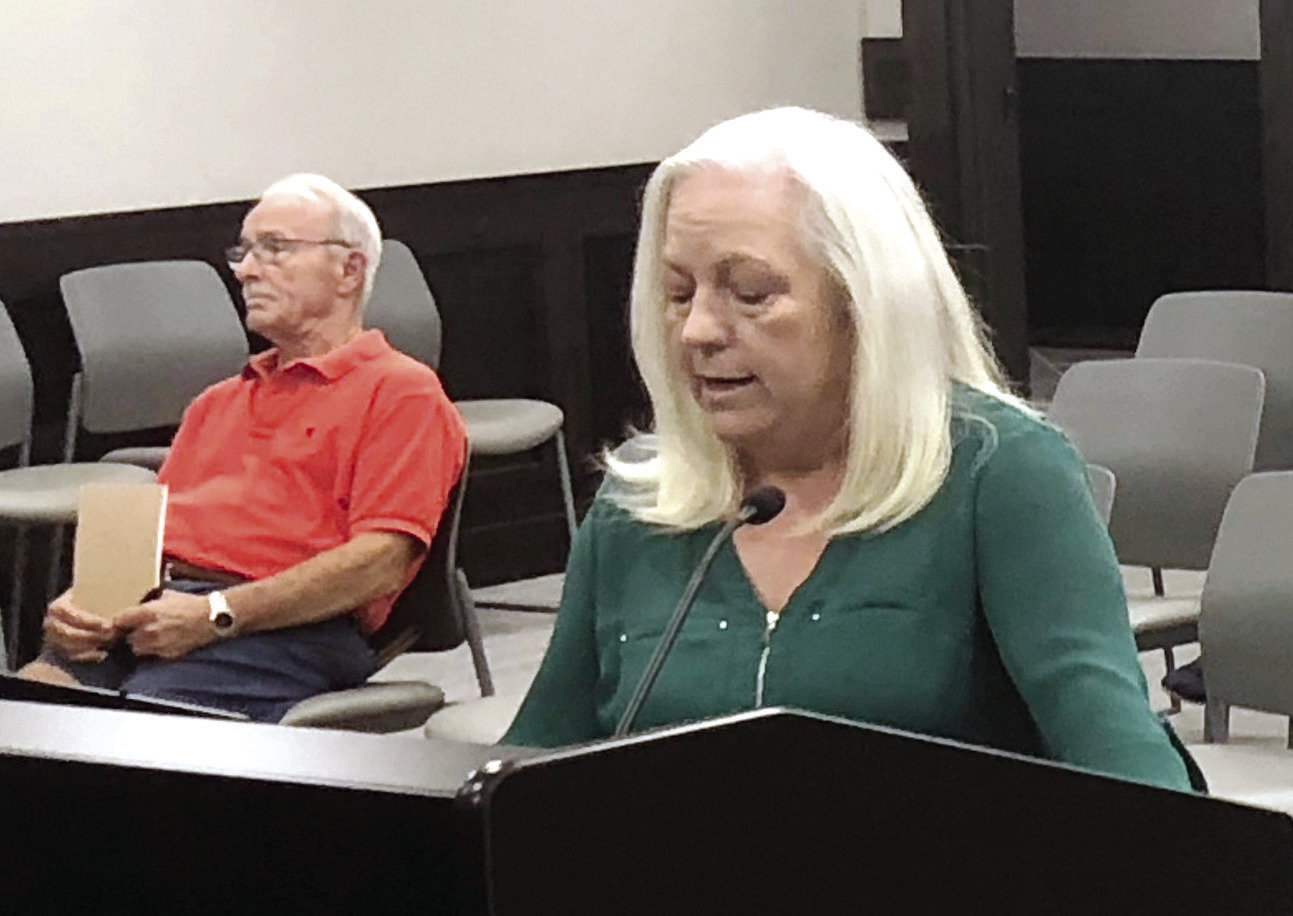
Several people in the audience also addressed the commissioners.
“I put it in terms of the hours of the year,” Tom Ptak said of his analysis of the notice of reassessment of his property. “At 8,760 hours in a year, according to the notice I got, my house increased almost $10 per hour for every hour of the year; the exact number is $9.60 per hour. My home value went up $84,000 in one year. I haven’t done anything but pretty much cut the grass.”
Wesley Milholen, who lives in Jones County near Haddock, and Ricky Giles both commented on any tax increase from the standpoint of landlords. Milholen told commissioners he owns 60 properties in Baldwin County, most of them rental.
“I agree, everything is going up, [and] the hardest decision you have to deal with is how to balance the budget. I realize that,” Milholen said. “But you can’t keep balancing the budget on the citizens.”
Giles, who said he filed seven evictions the previous week, the most in several years, advocated for a reduction in government services.
“My parents and grandparents brought me up when times were tough,” he reflected. “I was taught ‘buy what you need, not what you want.’ Let’s buy what we need for the county; don’t expand the government.”
Near the end of the hearing, District 2 Commissioner Kendrick Butts asked for clarification on what the rollback rate and last year’s 10.02 levy would mean for the county.
“The rollback rate would generate an additional $420,000 in revenue,” Hudson answered. “That makes up additions to the digest in new properties, additions to homes, anything that was not on the digest last year that is on the digest this year.
“The 10.02 is the rate we had last year. The difference in the two is the reassessed value. So, the 10.02 would generate close to $2.8 million.”
District 3 Commissioner Sammy Hall reiterated Hudson’s earlier comments during the second hearing that day.
“Eighty-five percent of the tax money we get is controlled by the state or federal government. It is mandated services we have no choice to provide,” Hall stressed. “Only about 15 percent of the money do we have input, direct choices to make.”
The final public hearing will be Sept. 30 on this item.