
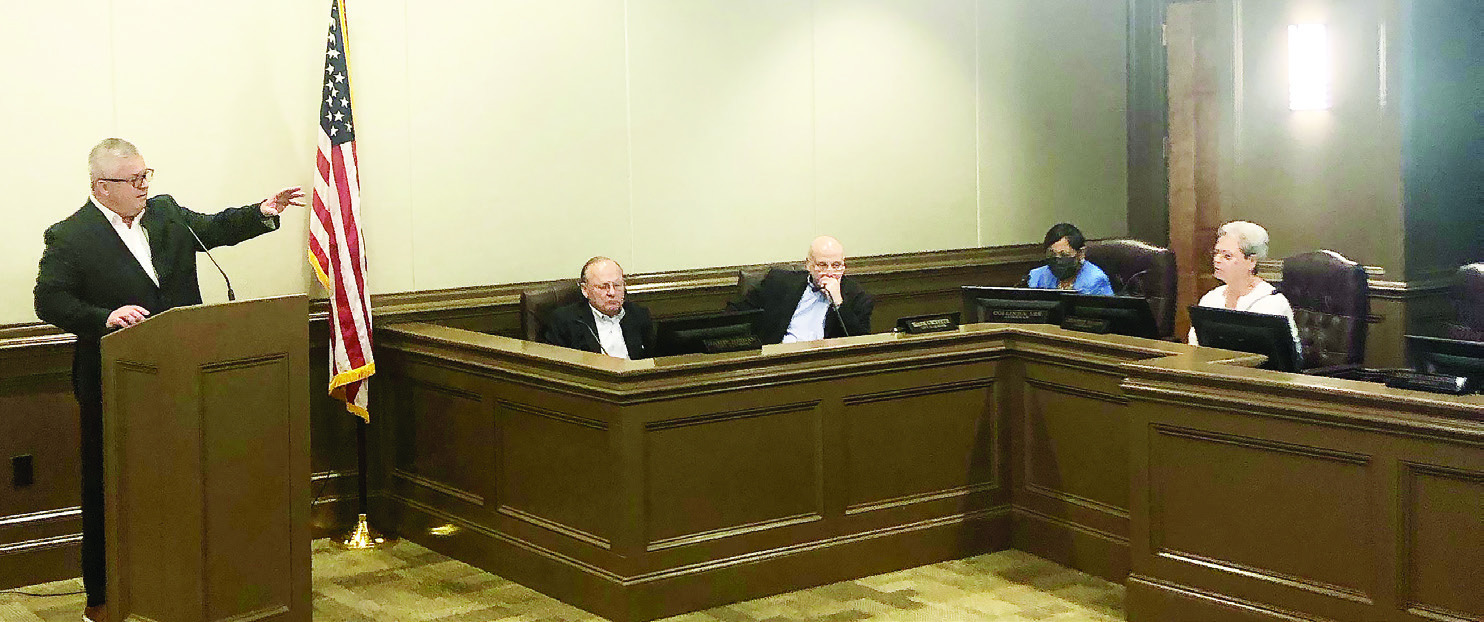
A multi-state medical cannabis-cultivating firm got the green light from the Milledgeville Planning and Zoning Commission for its rezoning request this past Monday evening, as the advisory board voted to recommend approval.
With only three members present, the board voted unanimously to approve the change from Community Commercial to Light Industrial. Their recommendation will go to the City Council at its May meeting for a final decision.
According to city zoning regulations, the first reading of an ordinance to rezone 3015 Heritage Place took place at the March 26 City Council meeting.
Jim Frazier of Sanctuary Cannabis attended both meetings, sharing a brief history of his company and highlighting anticipated plans in Milledgeville. He noted the company will have total control of the cannabis facility. A retail florist is located on the front side of the building but has a different address and no access to Sanctuary’s portion of the premises.
Frazier explained that Sanctuary is the operating partner, and Treevana Wellness is the license holder in Georgia.
Sanctuary began its operations in New Hampshire, then opened facilities in Massachusetts and Florida, with four operations now.
“We’re going to take the back side of that property and make a pod farm out of it,” Frazier said. “A pod is basically a container 40 feet long by eight feet wide. We convert those, making them grow rooms, dry rooms, kitchens, extraction labs.” He said the company also plans to use them for office space since they allow for quick set-up.
“What we would like to do is operate a cultivation unit,” Frazier told the zoning board. “We grow the product, we harvest the product, we process the product, and we extract the product.” He explained that extraction involves going through a combustible-type process that creates oil from the plants.
Frazier shared that the plan calls for two phases, the first being the installation of pods for the growth and harvesting process. That phase will need anywhere from eight to 12 people.
“Phase 2 will include harvesting, processing, and extraction,” he continued. “It will be anywhere between 30 and 50 jobs, depending on what type of equipment we end up putting in there for that operation.”
Frazier added the company has plans for retail sales, too.
“When we produce the oils, per state regulations, we will also operate dispensaries within the State of Georgia as well. The first dispensary will also be in Milledgeville,” he said. “So, I may be back in front of you for that at some point in time.”
Frazier also stressed security of the product always remains of paramount importance, explaining a platform named BioTrack is the standard employed within the industry. He explained it tracks everything from the time a seed goes into the dirt, to its growth as a plant, to its extractions reaching an end-user.
He said BioTrack allows the company to answer in real-time any questions about the product and emphasized security remains extremely tight with a security person living on the property amidst a strong presence of surveillance. Frazier said cameras are installed inside and outside the pods on the property and that Georgia requires the storage of camera footage for a minimum of 45 days.
“If something happened and we had to go back into the footage, we would be able to identify, okay, this happened on this date. Let’s go back, take a look, now we can identify and resolve whatever issues we may have,” Frazier said.
Planning and Zoning board member McKenzie Davenport expressed concern about the change in zoning. He noted all the properties in that immediate vicinity are classified as Community Commercial.
“My initial thought on it for discussion is the zoning being switched from commercial to light industrial,” he said. “I think anytime you’ve got a change in zoning, that raises an antenna on me because, instead of it being a special use or a one-time use, you’re now forever switching the character of that parcel, that address. We have to pay more mind to it when we are looking at a full rezoning.”
Frazier responded by stating the physical building will be used only to secure storage and for a kitchen that will be used in the future to produce other products that are not large or industrial in nature.
No one spoke in opposition to the zoning change, but Davenport reiterated his previous observations.
“I think, too, something’s got to be said for the actual application of what they’re going to be attempting onsite,” Davenport said, noting the florist outlet adjacent to the site. “That’s essentially what they’re going to be doing, growing plants, harvesting plants, then trimming, cutting plants. Then, they’re going to be putting these plants into some type of press, extracting oil. In terms of production, I feel like there’s not a lot of industrial-type work that’s going to be done on this location.”
Board member Emily Cook concurred, saying the actual usage was not a heavy industrial type, was contained, did not produce extreme noise or disruption, and operated during normal business hours. Given all those factors, she said, she could support the rezoning.
With presiding board member Donald Hill also concurring, the advisory panel gave its approval, recommending that the City Council grant the rezoning request.