
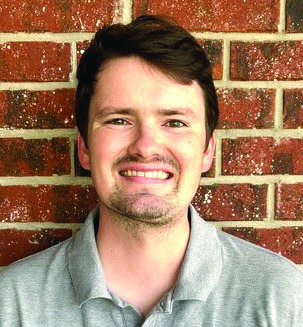
The Flannery O’Connor Institute for the Humanities awarded the 2025 Laidlaw Fellowship to Jack Love of Texas A&M University.
The Jean M. and William C. Laidlaw Junior Scholar Fellowship is founded by Mike and Wendy Laidlaw to support emerging scholars dedicated to advancing the study of Flannery O’Connor. The program funds research for “junior scholars” to visit Georgia College Archives and Special Collections at the Ina Dillard Russell Library and Andalusia Farm. Special Collections has manuscripts, papers, and books, and at Andalusia there is a display of artifacts and historical buildings for researchers to interact with and study.
“A junior scholar is someone in graduate school or in their first three years of their career as a professor. In the case of Jack, he is a graduate student working on his dissertation,” said Katie Simon, interim executive director of the Flannery O’Connor Institute for the Humanities. “This gift allows them to take their work to another level. They stay here for a week and work every day in the archives to incorporate that into their dissertation or first publications to help them do well in their career.”
Love is a PhD student in the Department of English at Texas A&M University and the second scholar to be selected. He will be coming to Milledgeville in May.
He previously visited Milledgeville in June 2023 for a month during the NEH Summer Institute’s “Reconsidering Flannery O'Connor,” where he learned from O’Connor experts and explored the GCSU archives. During his time at the endowment, he published work on Flannery O'Connor in Christianity & Literature and the Journal of the Georgia Philological Association.
“My dissertation includes the study of late 19th and 20th century American Literature with a focus on ecocriticism and the American South.
So, I am studying agricultural spaces and the way these spaces represent change and transformation in this time period in American Southern fiction and nonfiction,” said Love. “Flannery O’Connor plays a huge role in that with all of her farm fiction and general themes of her writing and the changing nature of the American nation at that time.”
O’Connor is just one of the authors featured in Love’s dissertation, alongside other authors such as Mark Twain and Zora Neale Hurston.
“I’ve had experience in GCSU archives looking at some of O’Connor’s materials and I was able to visit Andalusia Farm once during my time at the summer institute.
However, this will be a focused period of study into O’Connor to see how I can incorporate her work and background with these other authors,” said Love. “I plan to focus on material texts, explore Andalusia Farm and the materials in the interpretive center and try to visualize the space she was writing about and lived in.”
Love is most interested in how O’Connor depicts agricultural space and agricultural labor, which is why he wants to focus a part of his visit on Andalusia Farm itself. O’Connor lived and worked on the farm and completed the majority of her narrative work while living there.
“I truly am looking most forward to going back out to Andalusia to feel and see the space and interact closely with the staff,” said Love. “I plan to investigate many different aspects of the space and the interpretive center.”
According to Love, he has no plans to continue research on O’Connor after his dissertation but rather would focus on educating others based on what he learns throughout his time in Milledgeville.
“Once I graduate, I plan to stay in higher education and hope to teach American Literature and about my research. I started in the PhD program because I enjoy educating and being a teacher,” said Love. “O’Connor will continue to be a huge part of what I do and I plan to continually teach her in any classes I can incorporate her. She features prominently in the classes I’ve already had opportunities to teach so I continue to want to incorporate her writings into my teachings.”
According to Simon, Love will be invited back to speak about the results of his studies.
“They [the scholars] give back to our campus community by sharing their insight. A lot of these insights are exciting.
These are young scholars dealing with contemporary issues and people read O’Connor in different ways and different times given their lens, orientation, perspective, and the research they are able to do.”