
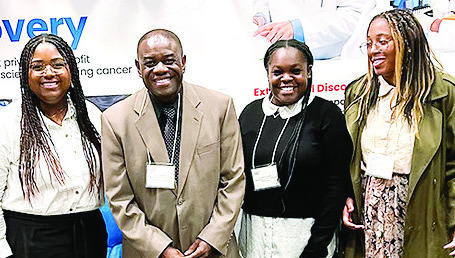
Georgia College & State University (GCSU) began a three-year program to provide underrepresented minority students access to research opportunities in the biomedical field this past summer.
The Diversity in Cancer Research Institutional Development Grant, funded by the American Cancer Society, encourages students to join research activities and pursue careers in research or the biomedical workforce.
According to a GCSU press release, “Initially the grant was offered to the Morehouse School of Medicine in Atlanta, but the school extended the program to Georgia College through a collaboration.”
The three-year program allows four undergraduate students each year to pursue research in the biomedical field for eight weeks.
During that time, they may engage with new research or expand on previous research while learning the basics of how to analyze, collect, and read data and professionally engage with new fields of research or build on the data presented. During the program, students will also present the research to professionals at different conferences.
“The goal of the program is to address the lack of diversity in the biomedical workforce by engaging students early on in their educational pursuits. They will get a sneak preview of what research entails and be encouraged to pursue their research beyond the program,” said Dr. Ernie Kaninjing, co-investigator of the program and associate professor of public health.
The Diversity in Cancer Research program provided mentorship to four students under the guidance of Kaninjing and Dr. Damian Francis, assistant professor of public health and co-investigator.
Each student researched something different from examining previous data on socioeconomic factors related to prostate screenings to research into breast cancer and the racial and geographic disparities when seeking post-treatment. One of the students even embarked on a new data collection looking at the perception of equality and the lived experience of men with prostate cancer.
“One of the strategic goals of the program is to also reduce health disparities in the community and provide access to healthcare to residents,” said Francis. “One of the things that we have been working on is reaching communities and understanding the barriers to care and barriers to access and providing means to overcome these barriers and pose a solution.
"So, the students in the engagement of this process help to carry out this work by collecting the data and analyzing the data and offering their solutions.”
According to Kaninjing and Francis, the program provides students an “early boost” into discovering what research entails and gives them a door into new or current research to explore. Students build connections and are set up to pursue the next step of their research, whether that be a career or graduate school.
“We are encouraging them to continue this research beyond the program,” said Francis. “It is giving them mentos and setting them up for a next step in the field of research or pursuing a career in the biomedical field.” Kaninjing added, “It gives them the ability to apply what they learn.
The program does not function like a regular class. We allow them to guide themselves. They have gained even further competencies in the ability to be ready for the workforce and can enter the workforce with at least three months of work experience.”
After developing their concepts and conducting research, students presented their work in July at a one-day symposium in Opelika, Ala., and a second time in October at the American Cancer Society Atlanta forum.
Since the completion of the first cohort, one of the students graduated and is currently at Emory University for her master’s in public health. The other three students who participated are being encouraged to join the cohort next year to continue their research.
“This program gives an overall good experience in both academic and life skill development,” said Francis. Kaninjing added, “In the end, the goal is to disseminate and have students go out and teach others what they have learned and inspire them. Ideally, we would like them to go publish but given the restrictions of time, it’s hard to collect data in larger samples to be able to publish but we hope to get to that point with later cohorts.”
The program will continue with more cohorts of four students. One goal for the next cohort is to have a male student pursuing research, as the first cohort was four female students.
Francis and Kaninjing look forward to the development of the collaboration and seeing what the next cohort can accomplish.