
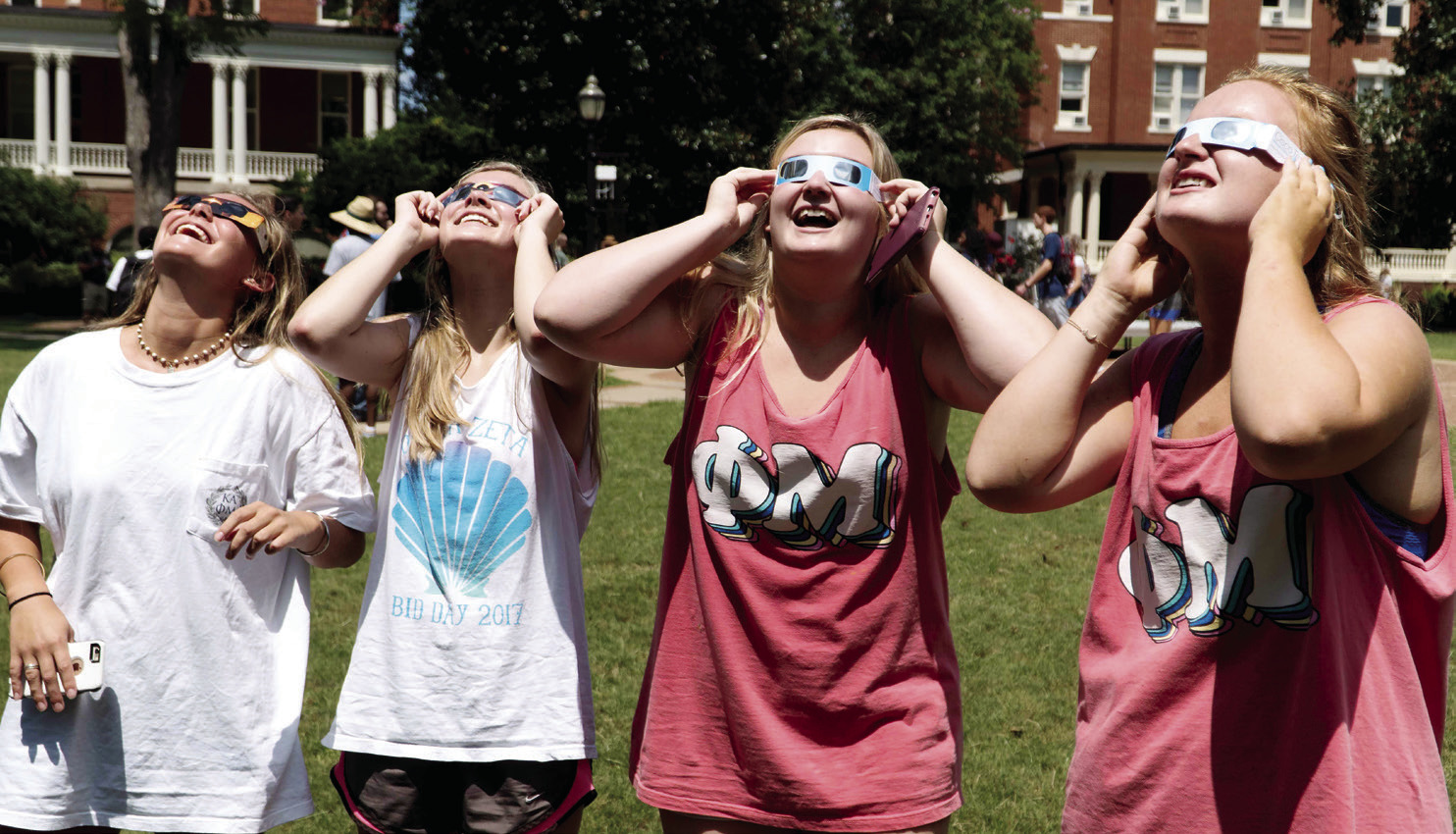
The total solar eclipse on April 8 promises to be an astronomical display that’s bigger and longer, brighter, and more spectacular than the last total solar eclipse that crossed America in 2017.
Georgia will not experience total blockage of the sun. But, weather permitting, residents will still see a remarkable occurrence, said Dr. Donovan Domingue, professor of physics and astronomy at Georgia College & State University.
It will be the last, partial eclipse visible to Georgians until 2045.
“Having to wait 21 more years to experience a phenomenon that historically has impressed so many people should encourage us to view this partial eclipse now or travel to its path of totality,” Domingue said. “The event can give us perspective on the connections between the sun, earth, and moon and our relative motions in space like few events can.”
Two important things make this year’s total solar eclipse more impressive than 2017. The sun will be close to its solar maximum (2017 was close to a solar minimum), and the moon will be a couple thousand miles closer in orbit to Earth.
This means viewers may be treated to large eruptions of solar material as they watch the eclipse, while a closer moon appears bigger and blocks more of the sun.
To learn more, come meet astronomist Dr. Domingue on Tuesday, March 26 at Mary Vinson Memorial Library in Milledgeville. He’ll give a public talk at 6 p.m. explaining the nature of solar eclipses, their history, and details about April 8.
As he did in 2017, Domingue spent many months traveling to schools in Baldwin and Jones counties, prepping teachers on the science behind an eclipse. He helped create informational lessons and activities for the big day.
Between the two events, Domingue also supplied about 30,000 safe viewing glasses to schools and local libraries. About 20,000 of those were handed out for April 8, funded by Georgia College’s Science Education Center, Department of Chemistry, Physics and Astronomy, and the university’s Astronomy Kaolin Endowed Chair.
Media and the public are invited to watch the April 8 partial solar eclipse from Georgia College. Weather is hard to predict, but a simulation at USA Today shows a 68% chance of clear skies in Milledgeville at peak viewing time, 3:05 to 3:40 p.m.