
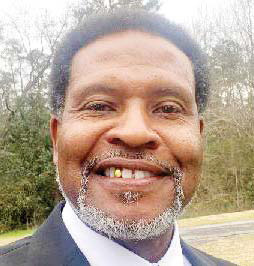
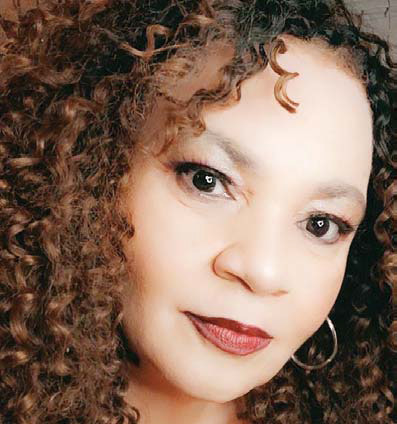
Rev. Harold Simmons and Beverly Lundy Hill are partnering together to honor and teach about the history of African American legends in Baldwin and Hancock counties.
Hill, who is from Hancock County, was a criminal investigator with the Georgia Secretary of State’s Office for 30 years and serves as the historian of the project. Simmons, a Baldwin County native, is working to help connect Hill to community leaders in both counties. Together, the two have started an annual banner project that will promote local Black leaders.
“We are standing on the shoulders of people we don’t know,” said Simmons. “They are our foundation and it's important for the community to know their stories and recognize not only who they are but what they accomplished.”
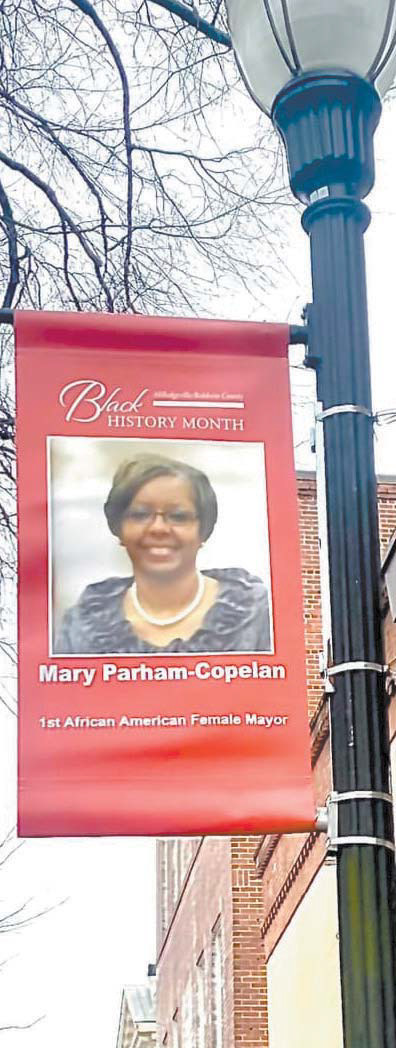
This year, 30 banners were displayed in Hancock County and 25 banners in Baldwin County. Each banner displays a picture of the leader, their name, and a short description of their legacy.
“The many nights of research were something I loved very much,” said Hill. Simmons added, “Putting their stories onto something tangible for everyone to see is a blessing. I’m just proud to be a part of this project and share this same passion that she (Hill) has.”
Simmons and Hill worked with the city council and county commissioners of both counties to plan and promote the project.
According to them, each county’s and city’s leaders were highly receptive to the project and showed a great amount of interest in bringing it to fruition.
“This isn’t just a project for Black History Month but something that memorializes our history all year long. These banners were bought by the people through donations and sponsorships, and they are for the people to use at any event,” said Hill. Simmons added, “They are also available to be an educational resource that our schools and local groups or businesses can use to teach.”
Hill originally saw the banner project displayed in Perry with over 60 banners around the city. The project was started by Phyllis Bynum-Grace, who was the first Black city councilwoman in Perry.
“I was captivated and mesmerized by the banners and intrigued to learn more about the people who were displayed on everyone,” said Hill. “I wanted to bring that same sense of curiosity and excitement to my hometown. I’m from Hancock County but Hancock County and Baldwin County are a team and have a lot of shared history, so we wanted the project to span both counties.”
Simmons and Hill plan to increase the number of banners for next year and have already begun discussions on how they could do that.
Due to the project having a late start this year, the banners will be up until mid-March but in future years they will be displayed from Feb. 1 through the end of the month.
“Even though we are celebrating Black History Month, what these people did was for everyone,” said Hill. “They made an impact not only on our city, county, or state but on the nation.” Simmons added, “It’s important for our kids to know where they came from and what kinds of things those before them accomplished and changed.”
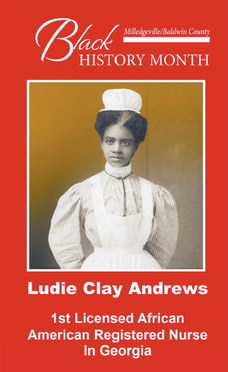
One example of these ‘legends’ offered by Hill during her meeting with the Baldwin County Board of Commissioners was the legacy of Ludie Clay Andrews, a local who pioneered the profession of nursing. Her family was originally from Hancock County and then moved to Baldwin County, another example of how history connects itself between the counties.
At just 13 years old, Andrews experienced a house fire that took the lives of her brother and sister and left other family members in critical condition.
With no burn unit in Georgia at the time, she nursed her family members back to health, which began her journey. Andrews later entered nurse training at MacVicar Hospital at Spellman Seminary in Atlanta and graduated in 1906. After graduation, she worked as an educator and fought for more than 10 years to gain eligibility to take the Georgia State Board of Nurse Examiners licensing exam.
“She was a teacher, and she developed the nursing skills they are using today,” said Hill. “When the licensing board was developed, they offered to license her, and she refused until all Black females were licensed.”
In the 1920s, she would pass that exam and open the door for all Black females to gain their license. Eventually, she also became the founder of the Grady Hospital Municipal Training School of Colored Nurses in Atlanta.
“Taking this project from an inspiration, researching these lives, and finally manifesting it into a final product has been the most rewarding part of this process,” said Hill. “We have received so much feedback from the communities and I’m glad it’s making that same impact on everyone as it did for me.”