
>> LOCAL HISTORY
Georgia’s Old Capital Heritage Center at The Depot, Inc hosted its finale to Evenings with History Tuesday night at St. Stephens Episcopal Church.
Georgia’s Old Capital Heritage Center at The Depot Inc. has been hosting Evenings with History for about 16 years. When the center had a museum, in the old capitol building, it was part of the mission to educate the public on the rich history of Milledgeville, Baldwin County and the Oconee River Basin which inspired this event.
Lecturers of local history present in January, February and March on different topics and presentations. Previously, this year, Christopher R. Lawton and Randy L. Reid discussed their book, Seen/ Unseen: Hidden Lives in a Community of Enslaved Georgians in January and Ashley Quinn, president of the Ocmulgee Archaeology Society and Natural History Collections manager at Georgia College, presented “Georgia’s Cemeteries and Stone Cutters” in February.
“Evenings with History enables the community to learn more about their local history and get involved with historic preservation. Every year, we have wonderful speakers who take time to share about a diverse range of topics,” said Amy Wright, executive director of Georgia’s Old Capital Heritage Center at The Depot, Inc.
In its final session, Charlie Brown returned to speak about the audience-requested topic of the Milledgeville Dummy Line Railway. Brown is a local railroad historian and author of Railroading in Milledgeville, A Researcher’s Guide.
He previously spoke at Evenings with History last year with a general summary of Georgia’s Railroad System, where he mentioned the Dummy Line and the audience expressed more interest.
“I’ve been a railroad enthusiast since I was 2 years old,” said Brown. “I always enjoy being able to share my knowledge and speak on the topic with others.”
Brown came prepared to speak about a timeline of the Dummy Line from its creation to its retirement. The audience was given multiple handouts that outlined the dates of major events for the Dummy Line, explained Milledgeville railway sidings, and featured a Union Recorder article discussing one of the Dummy Line’s street cars resting in a local’s backyard.
“The Macon Budget, another newspaper, wrote that “The Union Recorder suggests the building of a street railroad from the center of Milledgeville to the lunatic asylum. A good suggestion but wouldn’t it be better to have it built from one or both of the depots as it is intended mainly for visitors from abroad,” Brown quoted from The Macon Budget. "That’s what they did. They changed the idea to pick people up from the train on the Dummy to transport them to asylum and back.”
The ‘dummy’ was originally named the Milledgeville and Asylum Dummy Railroad. Its charter was issued on Dec. 24, 1888, and became known as the ‘Dummy Line’.
The term Dummy Line referred to it being a street railway. The original cars on the Dummy Line were named after the builder of the railway and its board members. The first engine was named after builder Sol Barrett, the first freight car was named W.L. Caraker and the first passenger car was named W.T. Conn. The first two cars on the Dummy Line were Porter cars #939 and #990.
“On Aug. 31, 1888, work on the Dummy Line began with 75 men working for 75 cents a day with no food provided,” said Brown. “When the Dummy Line was ready for passengers, it was 10 cents per Dummy ride.”
During his presentation, Brown told the audience of multiple stories of people riding the Dummy Line to visit Powell Park resided in the lower part of the Central State Hospital’s (CHS) Pecan Grove. The park was established as a part of the Dummy Line to encourage people to visit. It had a variety of entertainment from a band stage to swings and had plenty of outdoor seating.
People would gather to party and picnic while also touring the Lunatic Asylum (CSH’s former name) grounds. He also mentioned a story where, on some instances, young people would come to skate in the men’s building during the time that the hospital was short-staffed and beginning to fail.
“Oh, everyone was just having such a grand old time,” said Brown sarcastically. “And the Dummy Line rose in popularity out of curiosity to see the asylum.”
In July of 1890, the Dummy Line received its first lawsuit of many that would lead into its financial ruin in 1893. In June of 1893, the Dummy Line’s name was changed to the Old Capital Railway Company after being sold to the Milledgeville Railway, a company owned by people connected to the Georgia Railroad Company.
After being sold, it would go through many changes until 1917 when it gained an entirely new purpose, primarily caused by Powell’s notice to the public in July of 1894 that picnics or excursions to the Asylum were now prohibited. The Dummy was leased to the Georgia Railroad for freight service (though it had already done some freight service prior) on Jan. 28, 1917.
Once it became partially used for freight services alongside passenger services (which continued to dwindle), the Dummy Line would help transport material to the hospital, help transport brick to Georgia Normal & Industrial College (what became GCSU), and help to deliver other materials around the railway.
However, as the world advanced around the Dummy Line, passenger services were no longer needed and cars became the primary transportation.
In 1932, the Dummy engine and the Milledgeville Railway system were discontinued by the Georgia Railroad. After this date, the Georgia Railroad daily train visited the city each morning to switch cars to the state hospital and other institutions serviced by the old Dummy engine and crew.
On June 21, 1963, the Dummy Line would have its last run and passenger service from Milledgeville to CHS was terminated. By Dec. 4, 1973, the charter of the Milledgeville Railway and the ex-Milledgeville & Asylum Dummy Railroad Company was surrendered and the company was dissolved.
“If you look at your handouts, you will notice a Union Recorder article that talks about one of the Dummy’s streetcars still in existence. The car was adopted by Irene Brown and was converted into a summer tea house in her backyard. That is still where it resides today,” said Brown to the audience.
Throughout his presentation, Brown walked the audience through past and present to connect locations from Dummy’s history to what the audience may know today.
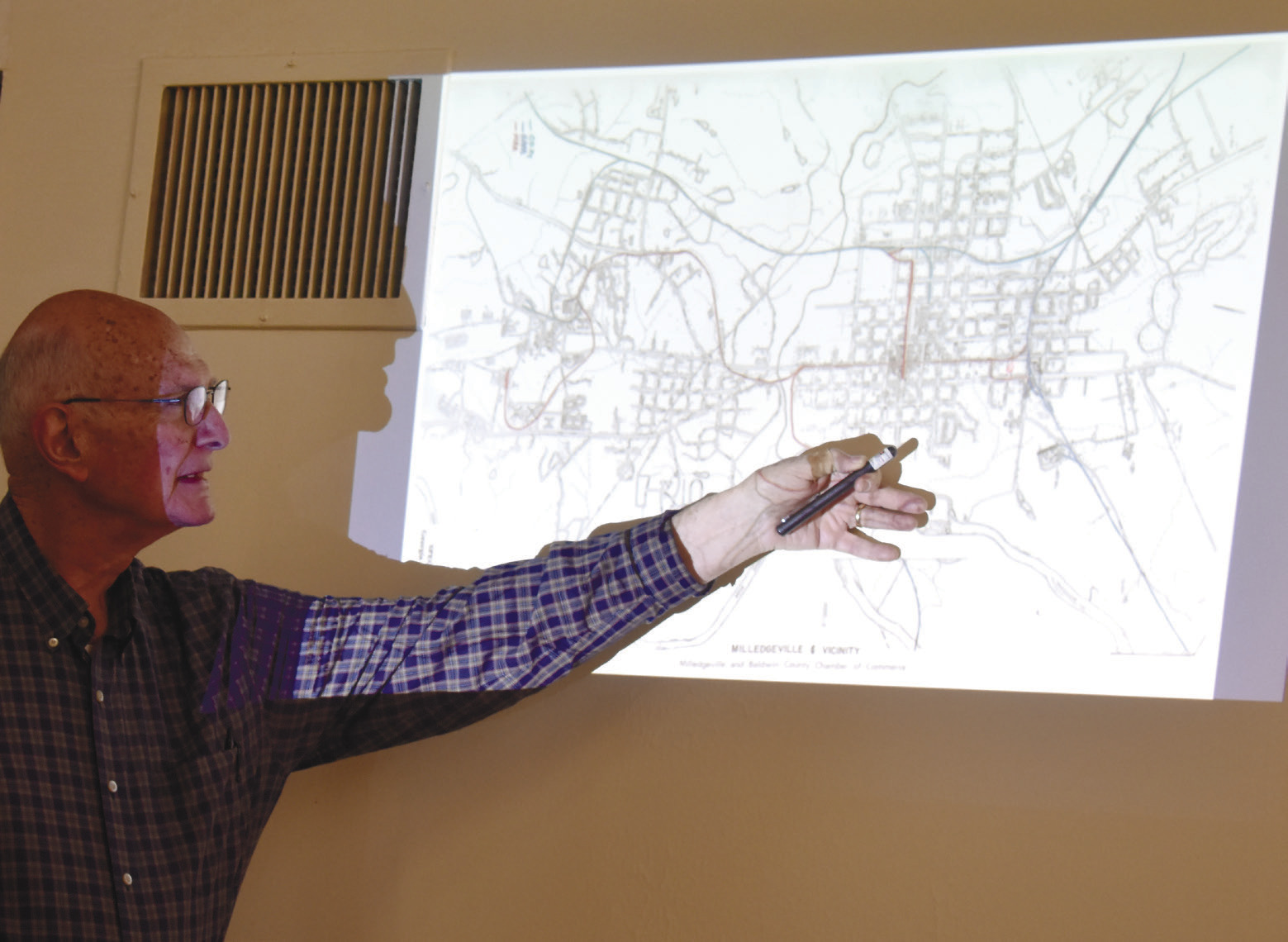
He collected various pictures that he presented to the audience and continuously referred to the railroad map to show the audience where the train traveled and how its line changed throughout time.
While the Dummy Line’s journey has been over for a while, Brown keeps its history alive and that is the purpose of Evenings with History.
“This was the biggest turn-out we had between our three sessions,” said Wright. “People seem to really love and enjoy learning about local and state history so we have thought about offering a few more sessions if there is enough interest.”