
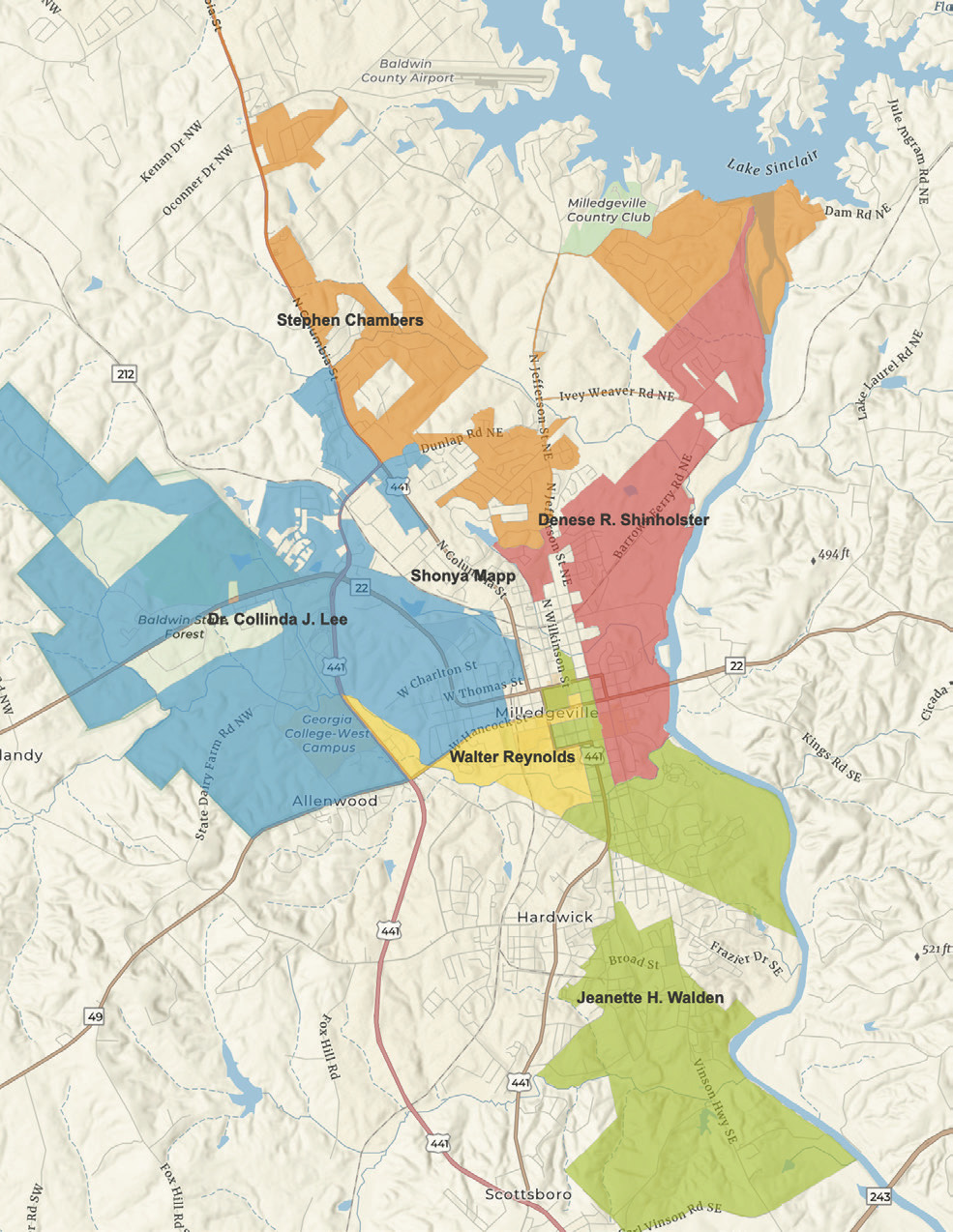
Milledgeville city council members and Mayor Mary Parham-Copelan held a work session on Wednesday, Feb. 12 in Macon to discuss redistricting Milledgeville council districts along with the Middle Georgia Regional Commission.
The council has six districts headed by six elected city council officials, Collinda Lee, Jeanette Walden, Denese Shinholster, Walter Reynolds, Shonya Mapp and Steve Chambers.
“The redistricting process has been ongoing, intermittently, since October of 2023,” said Hank Griffeth, city manager of Milledgeville. “The process is guided by the fact that local government districts are required to apportion their elective districts in such a manner as to guarantee their citizens’ constitutional rights.”
Each district is planned according to the reported population on the decennial census and the population of Milledgeville is estimated to be 16,486 people, according to the Georgia Municipal Association.
“The districts need to be realigned to have near the same amount of population in each district,” Griffeth said.
Geographers use the census data and different drawn maps to determine the best way to realign the districts according to multiple factors.
“Well, we draw the lines, and then we overlay those lines on top of the census data, and we extract not just the count of people, but the count of people by gender, by age, by race, by Hispanic, non-Hispanic,” said Doug Oetter, professor of geography at GCSU. “And then any other number of things that the Census Bureau reports, including income and jobs, occupations, education levels, all of that stuff can be garnered.”
The estimated cost for this is $500 or less, which will be used for printing of maps and whatever else may be needed. It is not a requirement that cities get redistricted after the census can ensure voting is fair.
“The overriding legal principle that triggers the necessity for reapportionment is referred to as ‘one person, one vote,’” Griffeth said. “The essential requirement is that districts within a political entity not be so disproportionately populated as to diminish the voting strength of any of the citizens.”
The plan will be accomplished through Georgia home rule powers and will follow the procedures under three ordinances.
The first ordinance is the Reapportionment of Election Districts for Municipal Elections. This gives the council the authority to reapportion the districts after the census comes out and that it can be done if the electors of these districts are denied the right to vote.
The second ordinance is the Adoption of Ordinances, Rules, and Regulations; Amendment of Charters and Amendment or Repeal of Ordinances, Rules, and Regulations by Petition and Referendum. This ordinance states that each municipal corporation has the power to adopt reasonable ordinances and regulations related to its property.
The final ordinance is the Filing of Charter Amendments or Revisions, Notices, and Affidavits; Publication and Distribution of Amendments and Revisions by the Secretary of State.
This ordinance states that nothing will go into effect until all proper paperwork is filled with the Secretary of State.
“They would probably not ask their people in-house to do it because it would bring a lot of consternation down on someone like the city planner,” Oetter said.
“That's why they would probably outsource it.
And that makes sense because you tend to get an unbiased opinion and you could argue that it was done more fairly.”
Council members have chosen to have the elected officials of the Middle Georgia Regional Commission draft the new realigned districts.
Choosing an outside person keeps the districts from being reapportioned or redistricted in a way that favors one political party over the other, which is termed as “gerrymandering.”
Public hearings and a passage of ordinances still need to occur before any redistricting can be completed. The next city council meeting is Feb. 25 at 5:30 p.m.