
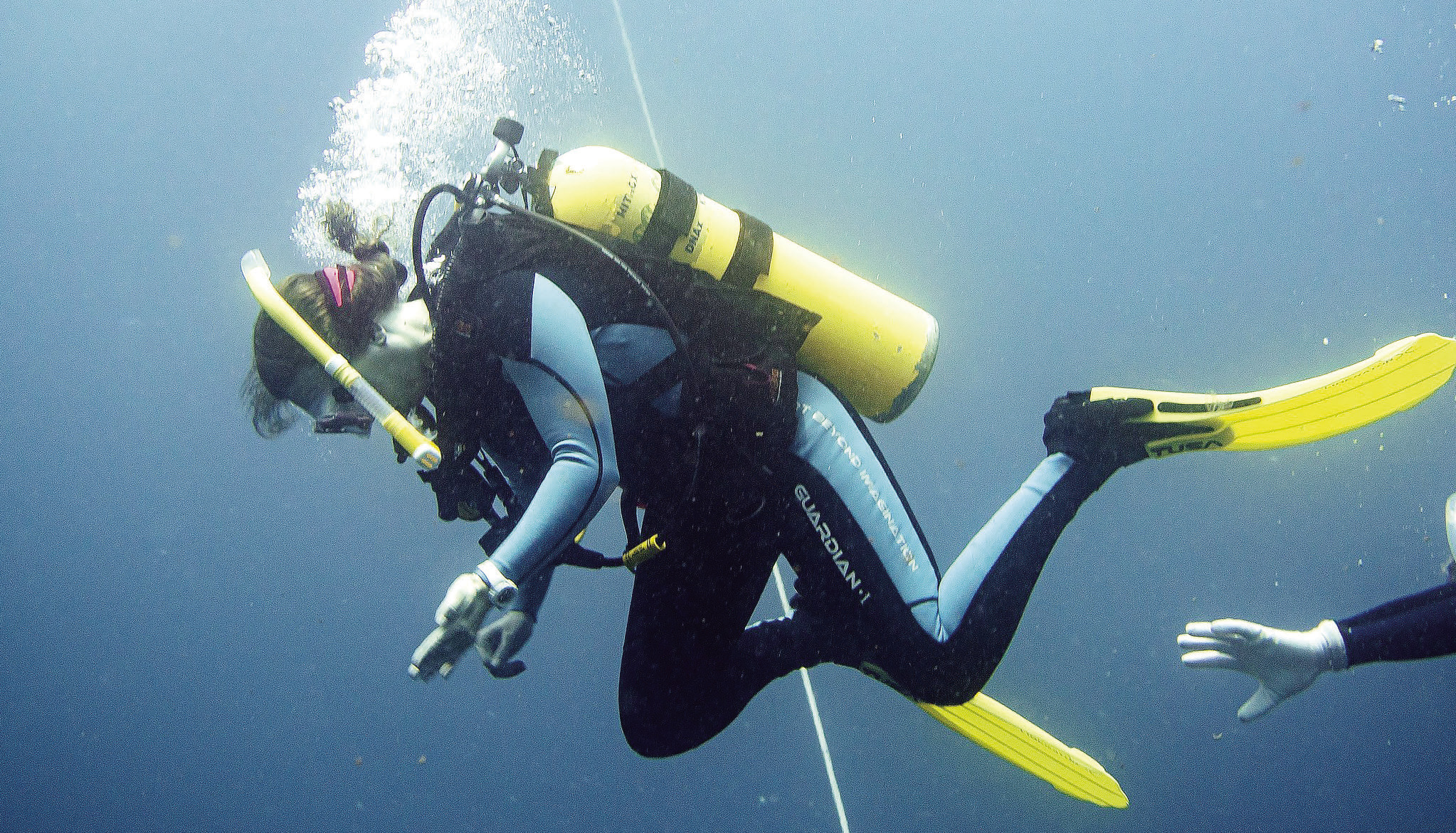
Four students in Georgia Military College’s (GMC) Biology Club embarked on an underwater fish survey July 17-19 near Panama City Beach to identify and collect data on a variety of fish species.
Last summer, club members participated in an “Introduction to Scientific Scuba Diving” trip and became certified open water divers. This summer, four students were selected to learn more about the sport of diving, how professional biologists use diving as a tool in their research, how to conduct underwater research, and about the variety of fish species found in the Gulf of Mexico. Through this training and an assessment by Reef Environmental Education Foundation (REEF), an international marine conservation group, the students became certified surveyors.
“We dove multiple wrecks including the Black Bart, the LCAC (Landing Craft Air Cushion) hovercraft, and the USS Strength,” said Mark Fairbrass, Health and Natural Science Department chair at GMC. “Panama City is an area with a large biodiversity including both tropical and temperate fish. It’s a great location for students to have a broader range of fish to identify.”
Fairbrass led the dives and stated that his students spent time in class learning to identify the fish before heading to Florida to conduct the underwater surveys. This was the first group to complete a survey since COVID put a halt to experiential learning trips.
“The students learned how to identify over 100 fish and how to safely dive while completing underwater ecological surveys,” said Fairbrass.
“The focus of this trip was to offer them real world experience that can be put on their resume and put their skills into action to contribute to REEF’s database. They are contributors to one of the largest marine life databases in the world and through their certification, they can continue to conduct these surveys on their own.”
According to the REEF website, during Roving Diver Surveys, divers swim freely throughout a site and record every observed fish species that can be positively identified. The search for fish begins as soon as the diver enters the water, and the goal is to find as many species as possible. At the end of the survey, divers record all fish encountered, assign the abundance of that fish based on different categories, and also note metadata, which includes things such as water temperature and depth. This data is then logged into REEF’s online database.
“During our dives the students identified many types of damselfish, little fish that make their home on the reef. They are pretty difficult to identify as there are many species that look very similar,” said Fairbrass.
“The students had to take a lot of time to notice the nuances that distinguish the different damselfish species.
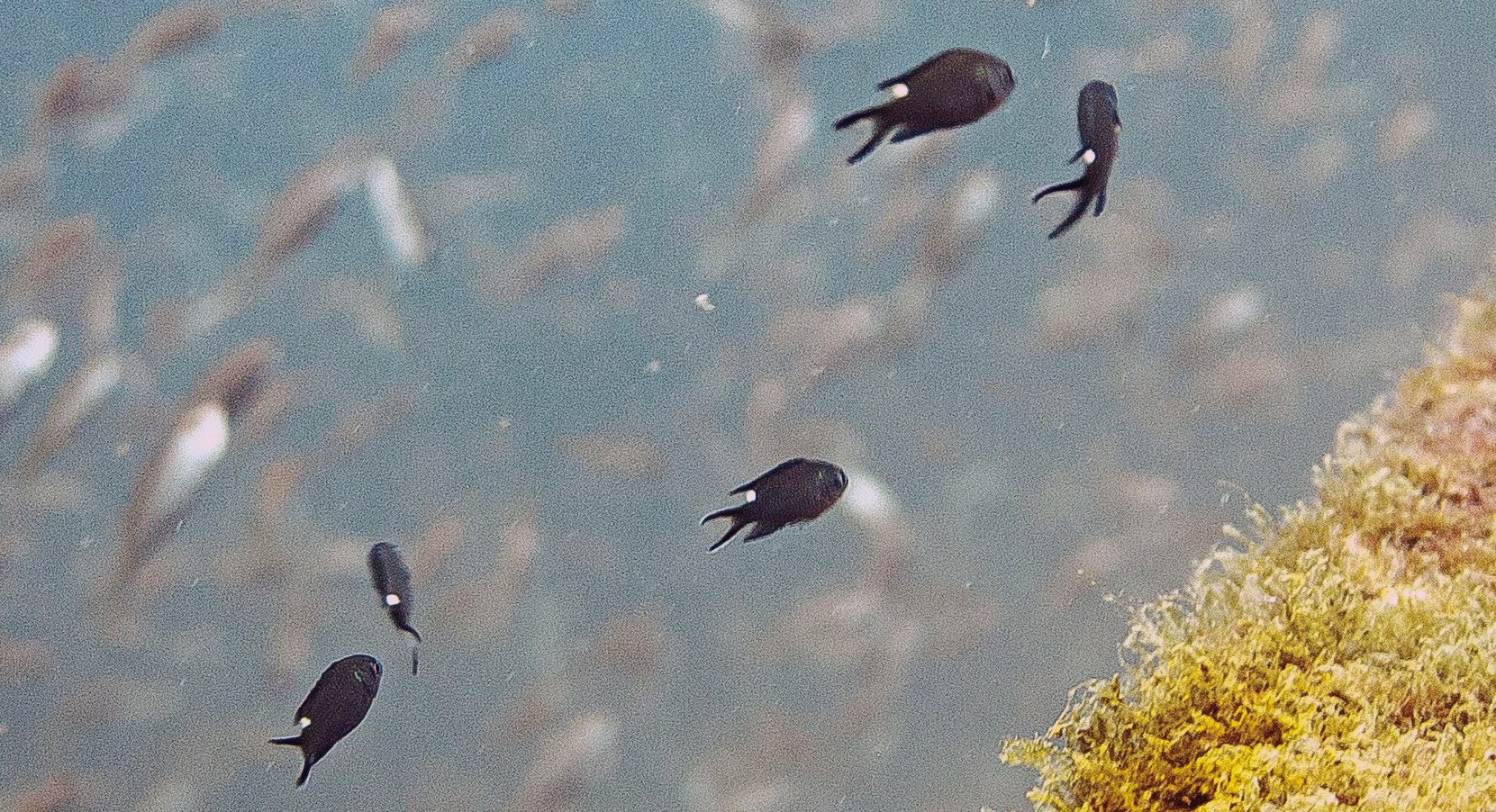
“One group of these fish, known as chromis, live higher up and feed on smaller animals. In our area there are only a few of them and they are very distinct,” Fairbrass explained. “The students identified a chromis with a big white spot on its back. It was not like any fish they learned about. I could not identify it and it wasn’t listed in any of the books we brought with us on the trip.”
Fairbrass recounts searching online and still not identifying the species. One of the students, Timothy, was able to capture photos of the fish and Fairbrass sent those to a few experts who identified it as a Regal Demoiselle ( Neopomacentrus cyanomos), a non-native fish to the Gulf of Mexico. They are an Indo-Pacific fish.
“We read a few research papers on the fish and did confirm they have been located in the Gulf before. When the oil and gas rigs were moved from the Pacific, the fish stayed attached to the ‘legs’ of the rig and moved to the gulf with it,” explained Fairbrass. “This was the first time they were found on the wrecks we were looking at. We saw about 30 on each wreck.”
Students submitted the data to REEF and the United States Geological Survey.
“Every time I take students on a marine biology field trip, we find something that I cannot identify. Normally other biologists cannot identify it. So, it wasn’t the fact that we found something new but that our students found it,” said Fairbass.
“They were interested enough to push the question out far enough to identify it and then record the data themselves. It shows their future employers, or grad schools, that they are determined and actively involved in biology.”
Biology Club trips occur through sponsorship and donations. Fairbrass expressed a desire to take more students on trips like this and to make it an annual event, so the experience, data, and certifications impact a wider range of students.
“We have so many students who desire to be involved and attend trips like this, but we don’t have the funds to take them all and we have to keep turning them away,” said Fairbrass. “Prior to COVID, we were able to fund larger groups and I am hoping we can do that again. These trips not only give them a unique opportunity but impact active research and each of their futures as they seek careers and further education.”
To support GMC’s Biology Club, visit give. gmc.edu and select JC Biology Club in the dropdown menu. All contributions are accepted, no matter the dollar amount.
“Any support will give students who may not otherwise have the opportunity to gain knowledge through an incredible learning experience and help GMC train the next generation of marine biologists,” said Fairbrass.