
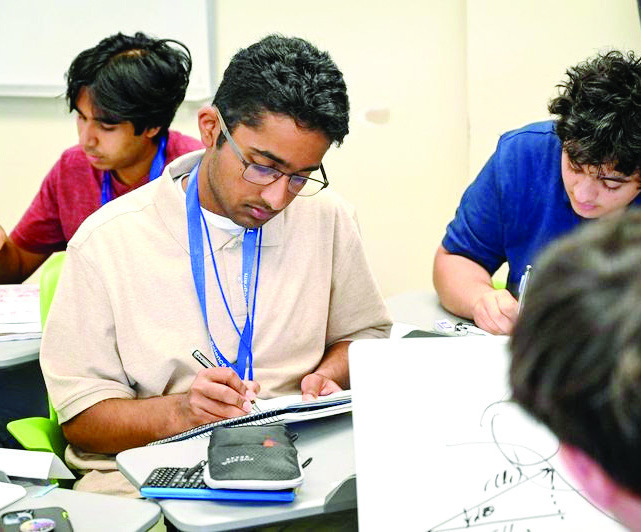
Georgia College & State University is one of three new schools in partnership this summer with SSP International, an organization providing stimulating and extensive science opportunities for motivated high school students since 1959.
The 5 1/2-week residency program at Georgia College began June 16 and runs through July 24. The focus is astrophysics and includes training on the university’s Pohl Observatory telescope to detect incoming asteroids.
“This is a competitive program with a small portion of applicants accepted, based on essays and academic prerequisites,” said Dr. Donovan Domingue, astronomy professor and academic director of SSP at Georgia College.
“SSP is an environment where we expect participants will be very collaborative and help each other through difficult material,” he said. “This group is very curious and engaged. They arrived with a tremendous amount of talent and knowledge.”
The Summer Science Program is considered the longest-running, research-based summer education program for high schoolers with rigorous, collaborative experiment-based study in astrophysics, biochemistry, genomics and synthetic chemistry.
By adding Georgia College, Georgetown University and Southwestern Oklahoma State University to its list of longstanding schools, like Purdue University, SSP International doubled its number of participants this summer to nearly 400.
Thirty-six high achievers signed up for SSP at Georgia College. They come from 15 states, a U.S. territory and four nations: California, Connecticut, Florida, Georgia, Idaho, Illinois, Indiana, Massachusetts, Michigan, New Jersey, New York, Oregon, Tennessee, Texas and Washington, as well as the Northern Mariana Islands, Turkey, Brazil, Ukraine,and China.
It’s not a program for loafers or the faint of heart. Participants are learning complicated formulas, Newton’s laws, Maxwell’s equations and Einstein’s relativity.
Pranav Avadhanam, a rising senior at Monta Vista High School in Cupertino, Calif., is good at math and AP Physics but admitted what he’s learning at Georgia College is fresh territory.
Recently, Avadhanam found himself at the board drawing equations for Lagrangian mechanics in Newton’s law and explaining his solution to the class.
He’d been exposed to the concept only 10 minutes earlier.
“It was a struggle for me at first,” Avadhanam said, “especially the astronomy and advanced physics. It’s a challenge, and I’m a little foggy on it. But the professors are extremely patient and very supportive and, of course, knowledgeable.”
Avadhanam would like to work in a STEM-related field someday. Being a part of the SSP program at Georgia College is a big step in that direction.
“For me, the biggest part of SSP is rapidly accumulating new information,” he said. “Learning to learn is the biggest thing. Picking up difficult math concepts on the fly is an important skill.”
Dr. Hasitha Mahabaduge, associate professor of physics and one of three SSP instructors this summer, said some coursework is senior-level college material. The program puts participants ahead in their studies and will help them stand out in college applications.
“SSP is not only a rigorous academic program,” Mahabaduge said. “Participants learn to collaborate with each other in an environment where there is no competition. When you see a bunch of 16- to 18-year-olds working on Lagrangian Mechanics on a Friday night, it truly makes me hopeful about the future.”
- Contributed