
>> EDUCATION
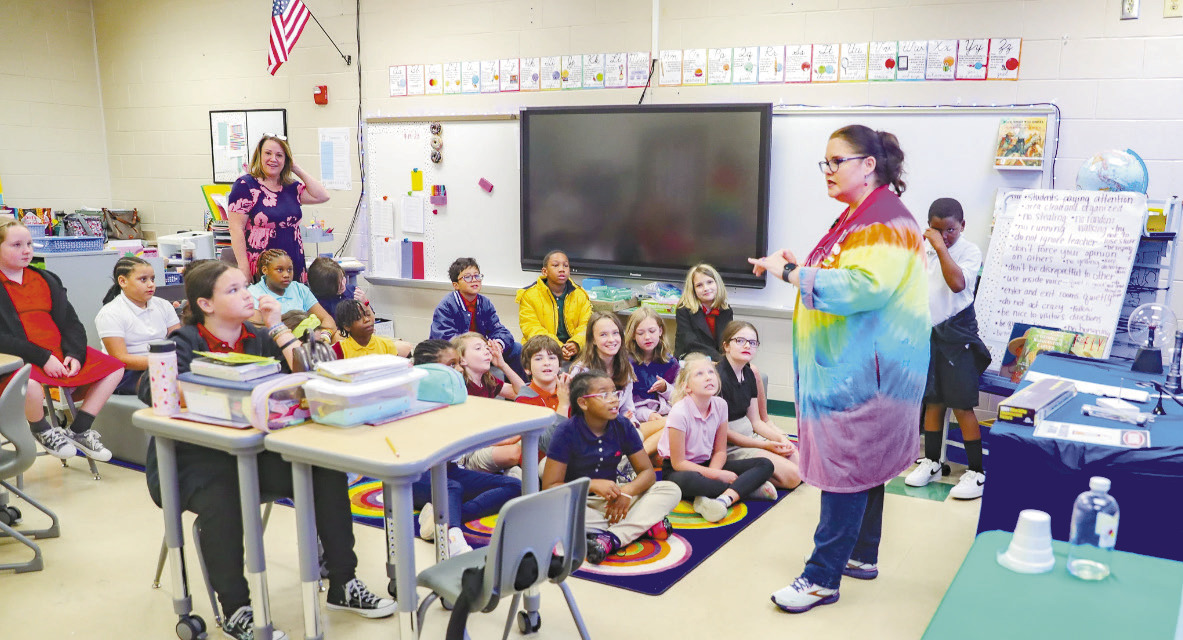
Lakeview Academy has been implementing Montessori teaching in its halls for six years, and students who have grown up with it are seeing the benefits as they prepare to transition into middle school.
According to the Montessori Northwest website, an organization that provides Montessori teacher preparation, Montessori teaching is a method of education that is based on self-directed activity, hands-on learning, and collaborative play.
According to Lakeview Primary teacher Judith Blout, who teaches Montessori style with kindergarten through second grade, and Lakeview Elementary teacher Erin Smith, who teaches Montessori style to fifth grade, Montessori is very “child-led” and “centered on what they (the students) are interested in.”
Blount has been teaching using the Montessori method for multiple years and works with multiple grades at a time. According to her, kindergartners, first graders, and second graders benefit by working together because of the mentor and mentee style and the flexibility to work on the “span.”
“I can tell the second graders to help check work, can you show them how to do these materials, etcetera. I can reach each kid,” said Blount. “Even when I was working in a traditional classroom, I had that span of abilities with kids who may not have been on grade level despite being classified as a second grader, for example. Montessori teaching allows the students to work at their own pace and improve through interaction with students on their level and above so they can continue to reach their grade level and beyond that.”
Blount also stated that a large benefit of the Montessori method for primary school is to work in small groups and alone.
According to her, students have more availability to explore more practical skills, develop social and emotional learning better than in a traditional classroom setting, and begin learning how to be independent early.
“Getting to teach in a Montessori classroom, they can do so much more. They just need the experience and a prepared environment,” said Blount. “We work in smaller groups to prepare them to understand the system so they can experience how to do work on their own and understand the curriculum and as they become more responsible and interested, we give them the independence to explore on their own and follow their lead.”
As the students transition into elementary school, they continue to experience a “child-led” approach while learning the required standards.
Rather than traditional lectures, students have more flexibility to reteach what they have learned and research new interests and different parts of the curriculum.
In Smith’s classroom, a large number of her current fifth-grade students are the first class to have been exposed to Montessori teaching from primary school through elementary. Due to this, students have more independence, and responsibility, better problem-solving skills, and are self-motivated.
According to Smith, her classroom specifically uses small group lessons and uninterrupted time to allow students to research or ask questions on their own, and balances that with shorter formatted lessons. Her class is very hands-on and teaches students how to study, self-pace themselves, and be more self-directed.
“Montessori teaching prepares them for middle school by teaching them how to direct themselves, pace themselves, and be responsible for their learning,” said Smith. “They are not dependent on the teacher and that makes the transition into middle school a lot easier. There is not as much of a need to adjust to those skills when they have been instilled since primary school.”
While the fifth graders are not taught using a multigrade system, they do interact with more community partners to be able to learn and explore with experts in their respective fields.
Recently, Smith partnered with Georgia College & State University and Georgia Power to organize a Chemistry Magic Show and the Georgia Power Learning Power program to come into her classroom.
“Both of these partnerships allowed experts to come into the classroom and help students explore lessons hands-on and assist them in answering their questions,” said Smith. “It delves into strengthening the critical thinking and problem-solving skills within our students so they can rely on themselves to dig deeper and answer complex questions.”
Neither Blount nor Smith could confirm or deny whether Montessori teaching may be implemented in middle school, however, both stressed the importance that the method has in preparing students for the expectation of independent learning in middle and high school.
“I think we should do it for every classroom,” said Smith. “It gives more preparation for what’s to come next.”