
>> GEORGIA COLLEGE
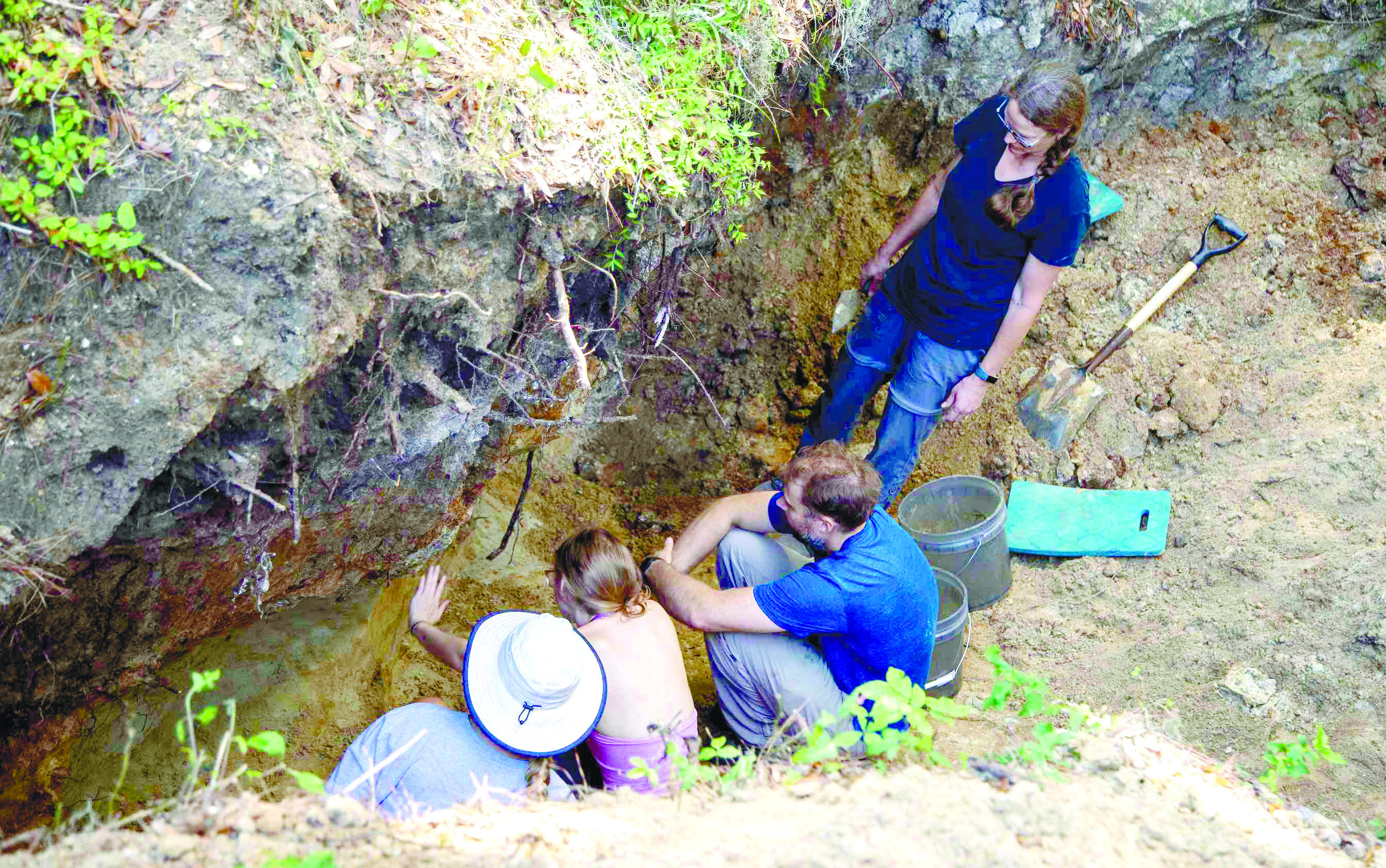
Paleontological dig shows a different Georgia
Imagine a Georgia—60,000 years ago—where the coastal city of Brunswick was 70 miles from the ocean and most of the state was a great, grassy plain where the bison and mammoths roamed.
“Paleontology is a true liberal arts science because of all the passion of discovery that foes along with the liberal arts,” said Dr. Al Mead, a biology professor at Georgia College & State University.
In an era when most people think paleo is a diet, a small public liberal arts school in Central Georgia is leading the way to unearthing this past. In doing so, it reminds the world just how hip and modern real paleontology can be. “Some people say paleontology is a dying profession and, at big research universities, that’s probably true. Many have eliminated their paleontology departments,” said Mead. “But in this environment, it can thrive. Paleontology is a true liberal arts science because of all the passion of discovery that goes along with the liberal arts.”
Mead is a paleomammalogist who studies ecosystems of the past. In the last 20 years, he and about 40 Georgia College students have dug and backfilled muddy trenches in the swampy marshes of southeast Georgia. Since excavating a near-complete bison skull in 2002, they’ve uncovered thousands of prehistoric bones, bone fragments, shells and teeth.
In recent years, scientists from other universities have joined the Georgia College team. They come together for a collaboration of minds, each sharing their expertise to help paint a better picture of what happened long ago at the Pleistocene-aged site.
“One of the primary lessons here is we’re looking at the effects of climate change,” Mead said. “There is a use for paleontology. If we understand history, then we can make a valid prediction about what happens next.”
The dig site—the only excavation of its kind in Georgia—was discovered by twin brothers in 2001. Joshua and Kelly Clark were in high school at the time but later got undergraduate and masters’ degrees at Georgia College in 2006 and ’09.
Sloshing through the creek on their family property, looking for salamanders to feed their pet turtle, they came across an enormous black bone sticking out of the muck.
Unsure of what it was, they gave the bone to their sister who was studying at the University of Georgia. Professors there turned to Mead, the area’s sole expert on fossilized mammal bones.
He took one look and knew instantly: It was the jawbone of a prehistoric bison—an enormous creature weighing about 3,000 pounds with a horn span of 7 feet.
“There is a use for paleontology. If we understand history, then we can make a valid prediction about what happens next,” said Mead.
Mead recalled reading about a similar find in the same area along the Brunswick Canal, dug in the 1830s. The dredging unearthed a large tooth, catching the attention of world-renowned geologist Sir Charles Lyell. He brought the fossil back to England for study. It was the remains of a Columbian mammoth—then long extinct.
“Finding mammoth bones only miles from the Atlantic “was just unheard of,” Mead said. “The giant, long-tusked elephant, like bison, prefers grazing areas like the American Great Plains.”
After the 1800s, talk of bison and mammoth bones in Georgia faded almost into legend—until the Clark brothers took their fateful walk. The jawbone they discovered proved giant prehistoric mammals did once inhabit Georgia. Back then, the environment looked much different than the seaside marshes and thick, Spanish-mossed forests we see today.
“Georgia would’ve been similar to the great prairies, not this jungle of trees we’re standing in now,” Mead said. “Paleontology gives us an indication of what the climate was like back then, what the vegetation was like and what kind of organisms lived here.”
“Today, we’re in a period where carbon dioxide levels in the atmosphere are increasing rapidly. 2020 was the hottest year ever recorded, since recording began,” he said. “What’s within the realm of possibility? Can it get much warmer? Has it been this warm before?”
Questions like these can be solved by examining riddles of the past.
Mead relies on scientists from other universities, like Dr. Alex Cherkinsky, a carbon-dating expert from UGA; Dr. David Patterson, an isotope paleontologist from the University of North Georgia (UNG); Chris Seminack, a sedimentologist from UNG’s Gainesville campus; and Russell Cutts, an anthropologist at Oxford College of Emory University in Atlanta. Other collaborators come from Kennesaw State University in Georgia, Temple University in Philadelphia and Utah State University.
The core team is a labyrinth of Georgia College connections— such as Mead’s wife, Heidi, the university’s fossil technician who teaches students to prep, catalogue and store specimens. Former students, like the Clark brothers, still contribute. Josh is an instructor and Kelly a lab coordinator at Brunswick’s College of Coastal Georgia. Josh co-authored a paper on snakes at the site, and Kelly is working with Mead to describe birds from that time.
Mead’s current graduate student, Todd Bennett, is researching rodent taphonomy— how biological material fossilizes after death—and looking for evidence of rodent bones from owl pellets to determine the ecological landscape.
“Science these days is not what science used to be. You have to bring in people who are relevant to your questions and experts in things that you are not. You have to able to work with them, listen to them. It really propels the project forward,” said Dr. David Patterson.
Bennett studied undergraduate biology at UNG under Patterson, who worked the site as a Georgia College undergraduate and graduate student, ’07 and ’09. Through carbon and oxygen readings in teeth, he determines what plants prehistoric animals were eating and what the environment looked like.
“Science these days is not what science used to be,” Patterson said, “where you can be an expert in every subject. You have to bring in people who are relevant to your questions and experts in things that you are not. You have to able to work with them, listen to them. It really propels the project forward.”
The dig site is a boggy acre named Clark Quarry after the twins. For years, only Mead and Georgia College students dug there. Some summers, they waded chest deep through tick-infested, cypress wetlands to get to the site—hidden off a residential road in Brunswick.
– Story and photos developed by University Communications