
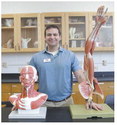
Sergio Patitucci has been a biology professor for nine years. Currently, he teaches anatomy, physiology and microbiology at Georgia Military College.
His passion for teaching stems from professors who mentored him academically and professionally.
Patitucci is one of about four million teachers in the U.S. On May 6, the nation celebrated educational professionals on National Teacher Appreciation Day. The event was founded in 1980 to honor educators.
Recently, The Baldwin Bulletin sat down to talk about the teaching profession with Patitucci, who moved to Milledgeville in 2009 to attend Georgia College & State University.
Q: What inspired you to become a teacher, and how has that inspiration translated throughout your career?
Patitucci: My faculty, actually. When I was in Americus at (Georgia) Southwestern (State University), where I got my undergrad, I took a class called herpetology.
I walked into the lab the first day and, as I walked in, Dr. Harrington handed me over a pine snake. I held that pine snake and I thought, “Well, that’s pretty cool. That’s a cool critter.” Anyhow, I sat down and he started lecturing. Just seeing the passion that he had and truthfully how happy he looked teaching about a subject that he was passionate about made me want to go, you know, “I want to be that guy.”
That was truly my first inspiration. Then, Dr.
Rod was my embryology professor, and he was really passionate about the subject as well. Between those two, honestly, just the passion and how happy they were in the classroom made me want to go, “I want to do that.”
Q: What is your teaching philosophy?
Patitucci: My main goal is I want my students to be better than I am. I want my students to be successful and to achieve all of their career goals. A lot of times as faculty we think we do a good job but that may not necessarily translate to students learning. As far as my teaching philosophy goes, it is providing an environment that will allow students with different learning strategies to learn ... I truly believe that being there for the student, being present for the student and being active in the classroom for the student is the most impactful way in helping them achieve their goals. They’re the reason why we’re here. They’re the reason why I get to do what I love to do every day.
Q: How do you approach balancing the curriculum requirements with encouraging creativity and critical thinking in your students?
Patitucci: I understand we’ve got to meet the curriculum requirements, but I at least do more than just that. I also like to include other aspects of the class that may not necessarily relate to the curriculum. For example, for our course learning objectives in some of my classes, I teach about other aspects of that particular topic that do not necessarily fit into one of the requirements. After so many years of teaching, you find that balance. My students have always been very receptive to what I teach in class.
Q: How do you think the role of teachers has changed over the years, especially with the rise of technology?
Patitucci: In one way, we kind of feel that we’re like police, where we have to look out for things that students should not be doing. Now we’re getting to the world of AI, and of course, things like Turnitin can only go so far nowadays because AI has gained some ground.
So of course, we’re now also dedicating class time reminding the students to think critically and to do their own work and things of that nature. In terms of social media, we’re seeing the students carry a bit more pressure and weight on their shoulders from societal pressure. You know, and also the fact that we’re in a more competitive world nowadays and things are now more evident to the students. Especially in my field, nursing is very competitive. You know, students carry a lot of pressure: “Oh, how well am I going to do on the TEAS test? If I get into nursing school and I graduate, how well am I going to do on the NCLEX so I can become a registered nurse?” And so forth. I tell my students, “Hey, I am not a counselor, but I am a set of ears. Come on, talk to me.”
Q: Tell me about the influential mentors or teachers who have impacted your journey as an educator.
Patitucci: Dr.
Harrington, Dr. Arata and Dr. Parmley are my three inspirations. Dr.
Harrington and Dr. Arata both passed and then, of course, Dr. Parmley retired from Georgia College a few years back.
We still keep in touch and go to the reptile shows together. The three of them truly did influence my professional life when I came to the (U.S.) in 2004. My goal was to be a physician and that changed whenever I stepped into Dr. Harrington’s class ... Having such inspirational professors made me want to go back into the classroom.
Q: What are common misconceptions about the teaching profession that you would like to debunk?
Patitucci: In theory, sometimes, students think we know it all. You know, at least they expect for us to know everything but we don’t. The one thing that I could say is that we all have our own little niches that we’re specialized in. We know that particular niche well enough to where we can break it down for students to actually be able to comprehend and understand the concepts inside of that particular niche.
Q: How do you think National Teacher Appreciation Day impacts the perception and appreciation of teachers within the community and among students?
Patitucci: I think it’s nice for students to see the administration of an institution recognize faculty simply because a particular student may not realize the impact that faculty or teachers have on students. And whenever they see administrators recognizing the effort of the faculty, perhaps the average student may go, “Oh, wow, you know, these folks are actually out here working hard.
Maybe I should pay more attention.”
The best appreciation I could get is whenever my students walk into my class, energized, ready to learn and excited. That tells me that this student acknowledges what I’m teaching and is ready to learn from me.