
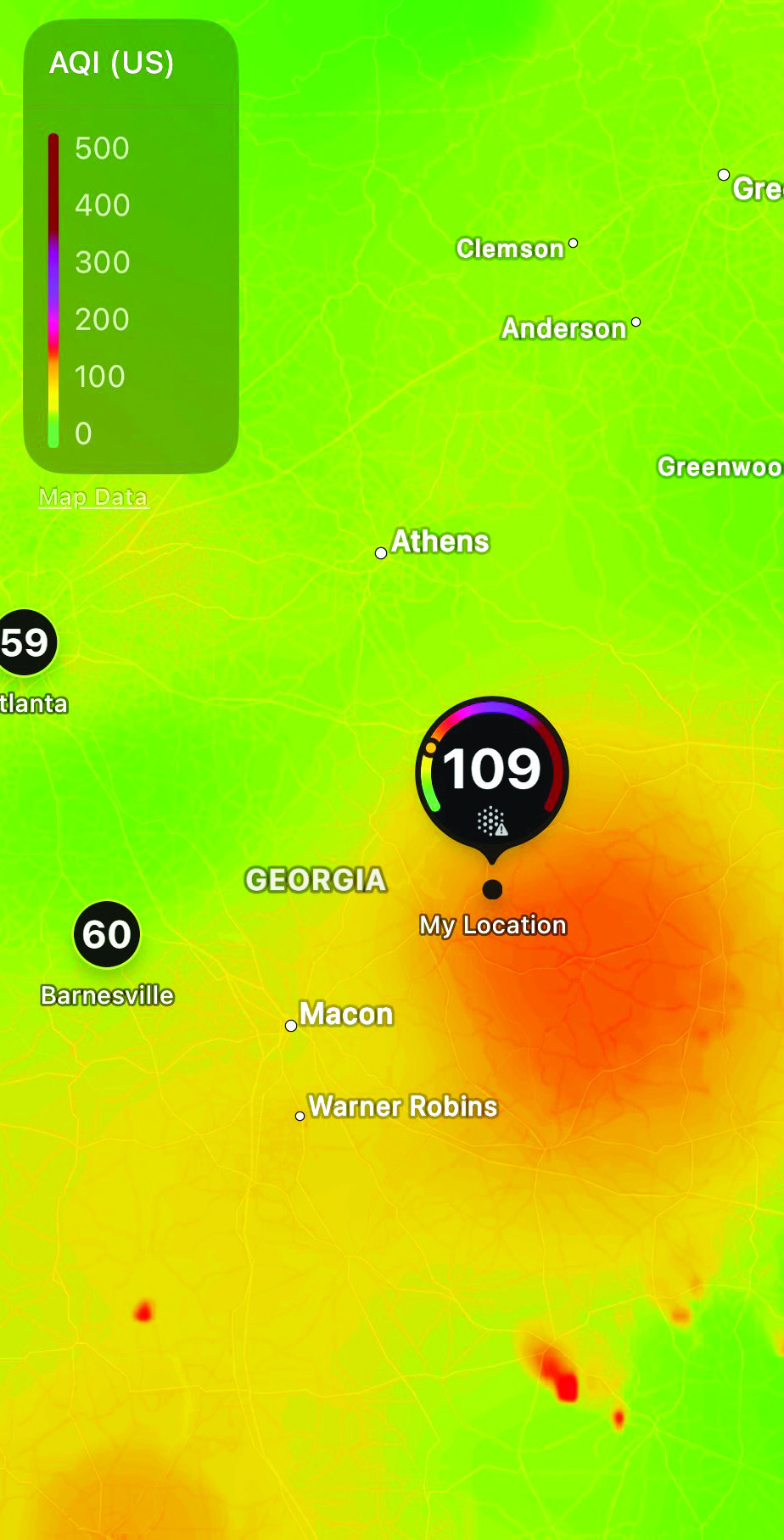
In recent weeks, Baldwin County residents have been informed through weather alerts that air quality conditions are “unhealthy for sensitive groups.”
Outdoor air quality becomes unhealthy when certain pollutants build up in the air. The American Lung Association claims that unhealthy air mainly comes from emissions produced by vehicles, power plants, and industrial facilities that burn fossil fuels. Smoke from wildfires and other natural events can also worsen air quality.
Air quality is measured by Air Quality Index (AQI), which monitors the air for toxins, VOCs (volatile organic compounds), lead, ozone, sulfur dioxide, carbon monoxide, nitrogen dioxide, particulate matter and meteorological conditions.
Weather patterns affect many meteorological factors that influence air pollutant concentration levels. Bill Murphey, Georgia’s state climatologist with the Department of Natural Resources, explained that calm winds and stable high-pressure systems can allow pollution to build up near the ground.
“Under light or calm wind conditions and underneath a strong high-pressure system and stable conditions, particle pollution levels can become elevated,” Murphey said. “If it’s a hot summertime day with those same stagnant conditions, ozone can become elevated.”
Certain weather events can also worsen pollution levels by limiting vertical mixing, the upward and downward movement of air. Cloud cover, precipitation and seasonal temperature changes play a role in determining how pollutants accumulate or disperse.
“Once wind or vertical mixing increases, air quality improves, which is why forecasts are so important for protecting sensitive populations,” Murphey said.
People who need to take precautions against air quality when it is deemed unhealthy for sensitive groups depend upon AQI data on whether the air quality is unhealthy because of ozone or particle pollution.
According to the AirNow AQI guide, ozone may affect children, someone with lung disease and older adults. Meanwhile, particle pollution affects anyone with heart or lung disease, older adults and children. Even people who are active outdoors are considered sensitive and may be at risk, even if the general public is not affected.
Once air quality reaches levels considered unhealthy, very unhealthy, or hazardous, the general population is affected and many are at risk. Anyone at risk is encouraged to stay indoors and run their air conditioners on recirculation to avoid toxic air entering their homes.
Residents can help improve air quality by walking, biking, carpooling, or using public transit instead of driving alone.
At home, conserving energy, using eco-friendly products, and avoiding burning yard waste can reduce pollution.
Residents can monitor current conditions and forecasts through the Air Georgia and AirNow websites, which provide hourly and daily AQI data and explain associated health risks.