
Typos happen. The Baldwin Bulletin occasionally has them.
Apparently, the Georgia Department of Transportation occasionally has them, too.
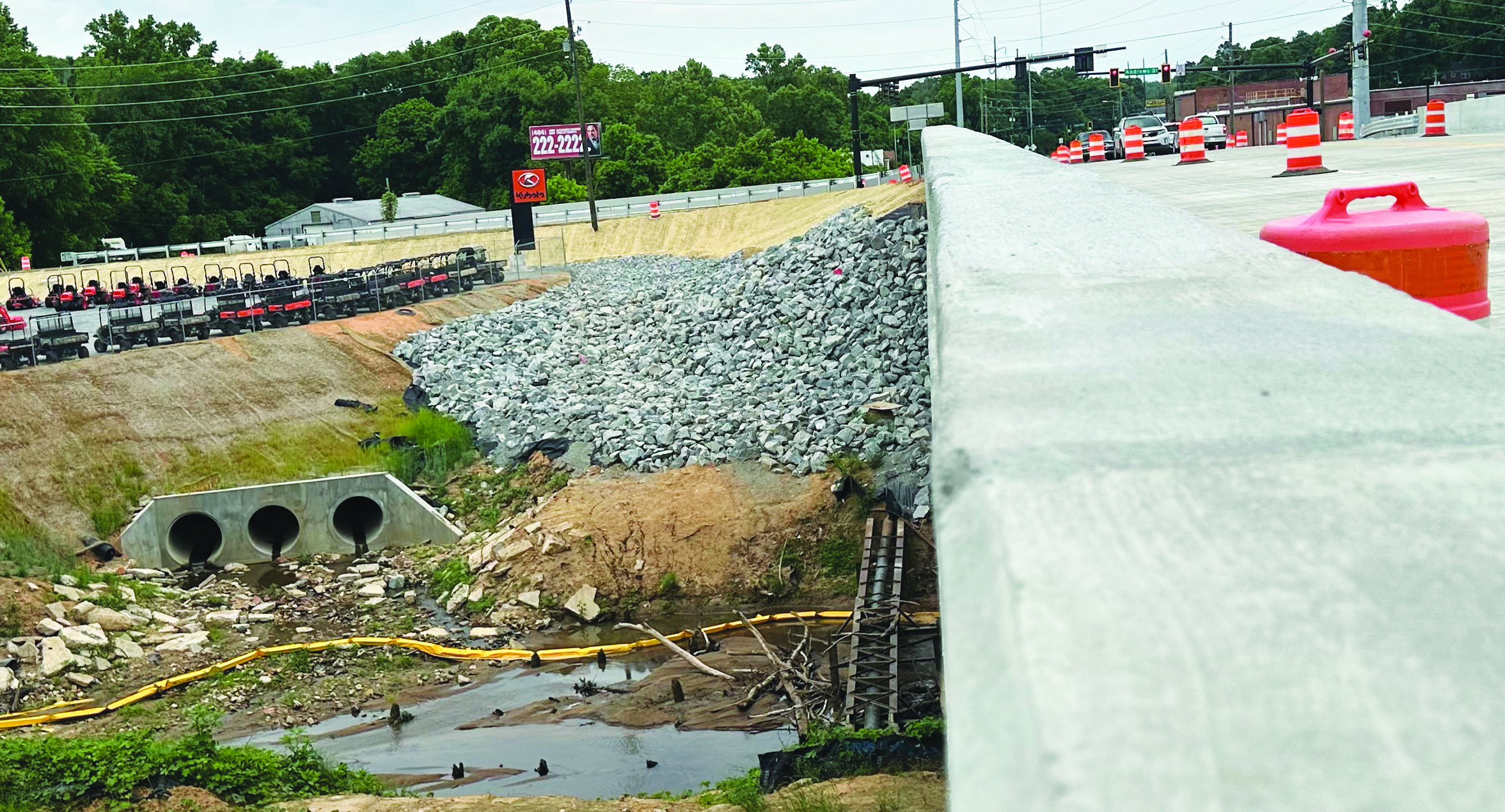
The Mayor Harry G Bone Bridge reopened to motorists over the weekend after being out of commission for the previous 360-something days. The bridge is noticeably taller and has a pronounced slope.
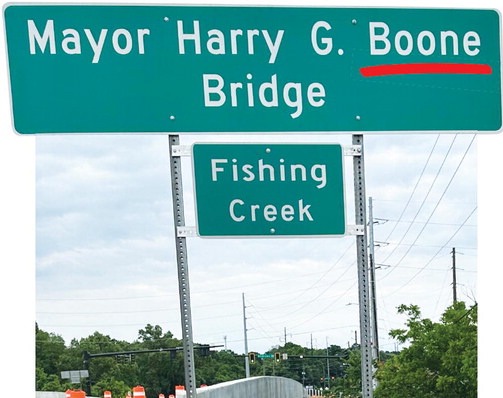
Something else motorists may notice is an extra (o) in Bone, both on the northbound bridge sign and the southbound bridge sign. For the time being, at least, people crossing Fishing Creek on Wayne Street will be using the “Mayor Harry G. Boone Bridge.”
Will Volk, a GDOT spokesperson, said on Wednesday that “new signs have been ordered.” Added Volk: “We will do a temporary fix until the new signs come in. They’re going to do that this week.”
Harry Bone was the mayor of Milledgeville from 1948-1952. Evidence of Bones can still be found around Milledgeville. One of Harry’s brothers – Frank – owned Oconee Clay Product Company and Bone Brick Company. Frank is the Bone in the Wooten-Bone House, now owned by Georgia College & University. Frank Bone Road, of course, is a convenient cut thru road between West Hancock Street and the southside of Milledgeville. Another brother – Russell – established the Bone Cemetery on Martin Luther King, Jr. Drive. The Bone brothers were viewed at the time as “progressive.” Harry Bone advocated for African-American higher education causes. Also, the idea of a white man starting a cemetery for African-Americans was a polarizing topic in those days.
Getting back to 2026, the new Harry G. Bone Bridge is 10 feet taller than its predecessor. In turn, the intersection of South Wayne Street and Andrews Street also is taller. A series of concrete walls, roughly three-feet tall, now line the block of Andrews between Wayne and Wilkinson streets. The walls run the length of the old Shaw Floors property, as well as Wayne Street heading into the Town & Country Shopping Center. S&R Package Store, known in southside parlance as “The Purple Store,” now basically sits in small valley, with concrete walls lining the edge of its property on both Wayne Street and Andrews Street.
The original price tag was for the 77-year-old bridge replacement was $14 million, but it’s since expanded to $20 million.
Wayne Street is still technically a state route, which is why the DOT oversaw and funded the project. If bridge replacements on nearby Wilkinson, Jefferson and Elbert streets ever occur, that would be on the Milledgeville city government to finance and oversee.
Prior to the opening of the bypass in 1989, Wayne Street winding through that part of Milledgeville actually was a United States highway – US 441.