
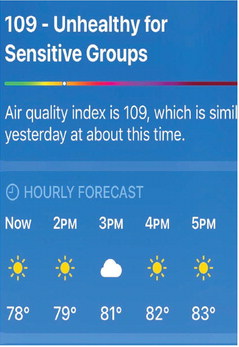
March 21 marked the first Saturday of spring, and the weather was spectacular.
Around Baldwin County, however, a relatively thick haze of smoke lingered later into the afternoon, especially in low-lying areas like the Oconee River Greenway, which basically looked like an old Grateful Dead concert.
The main culprit was a controlled burn at the Piedmont National Wildlife Refuge, located roughly 35 miles west of downtown Milledgeville. The 35,000-acre national wildlife refuge was established during the Great Depression and “is home to a growing population of the endangered red-cockaded woodpecker.” The prescribed burns help prevent forest fires in the refuge, but the burns also help grow the endangered woodpecker population.
The Georgia Forestry Commission (GFC) was responsible for approving the controlled burn permit in the Piedmont refuge on March 21, as well as other smaller burn permits around Baldwin and surrounding counties. As it turns out, the impact of the smoke caught the GFC by surprise, according to Thomas Barrett, the agency’s fire chief. In an interview with The Baldwin Bulletin, Barrett said the GFC looks at lesser-known weather indicators like the “smoke dispersion index,” “transport wind speeds” and the “mixing high.” When analyzing the Saturday forecast earlier that week, “all the weather parameters for Saturday looked favorable,” in terms of having minimal impact on people with breathing issues and people with outdoor plans scheduled, according to Barrett. At some point on Saturday morning, however, those conditions changed.
“If we’d have known that the smoke was going to stay down that low, we wouldn’t have issued those permits,” Barrett said. In other words, the GFC doesn’t automatically approve controlled burn permits, and the agency considers the impact that they have on people in nearby cities and counties. “We definitely acknowledge that the smoke got pretty bad that afternoon and understand the inconvenience that it caused for some people. That is not our goal,” Barrett said. Coincidentally, the haze that hovered around Baldwin County on March 21 occurred just several days after the Georgia General Assembly passed House Bill 983, which states that “no additional restrictions provided by local ordinance shall prohibit burning the understory for the health of the forest and wildlife or prohibit the landowner’s ability to reduce fuel loads on the forest floor.”
In other words, even if enough people complained to the Baldwin County Board of Commissioners about controlled burns on the weekends, there’s nothing that county commissioners could do about it.