


Georgia’s Old Governor’s Mansion hosts Death After Dark each October, allowing people to tour the mansion by candlelight after usual hours to learn about legends, death, mourning practices, and more from the 19th century.
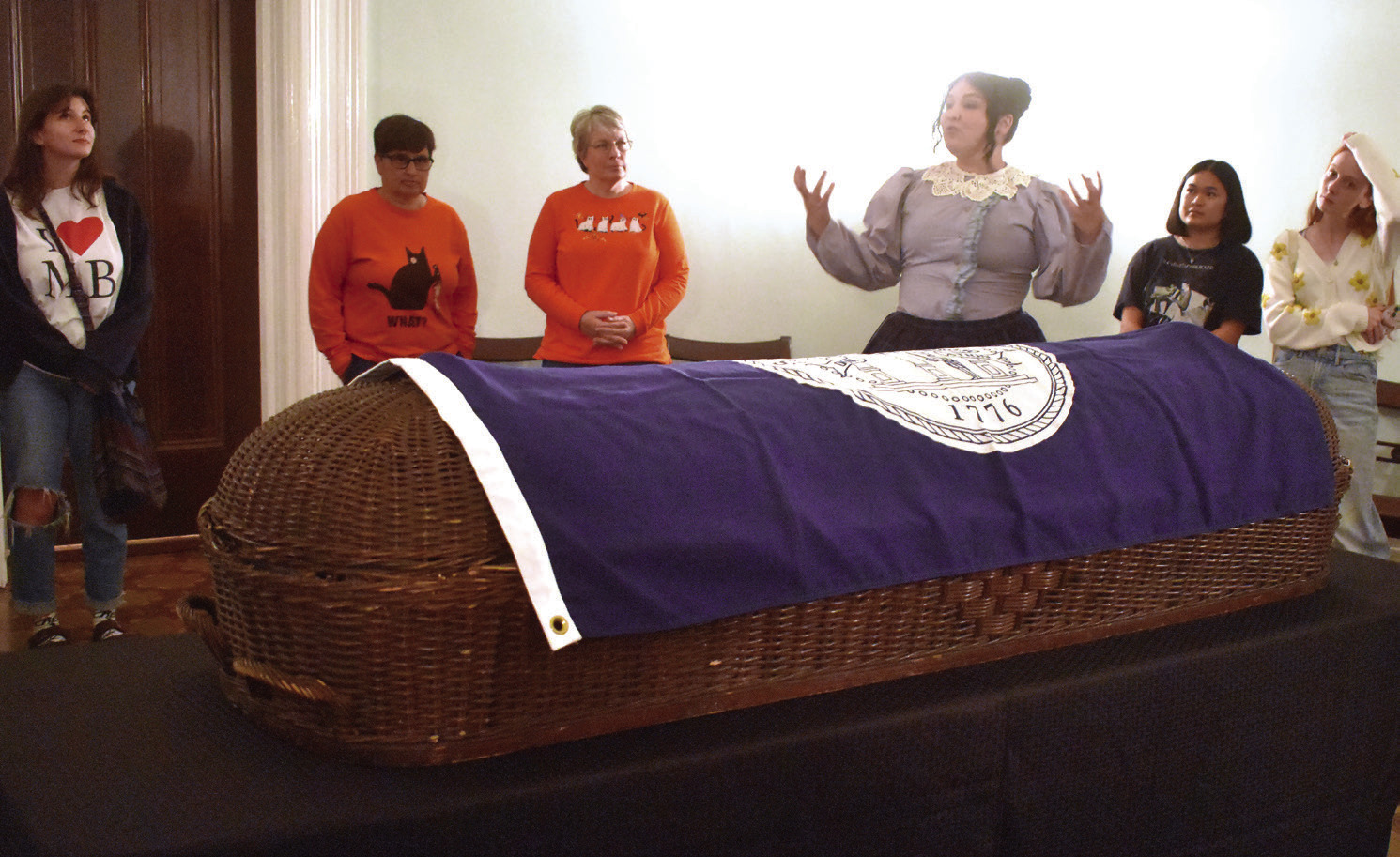
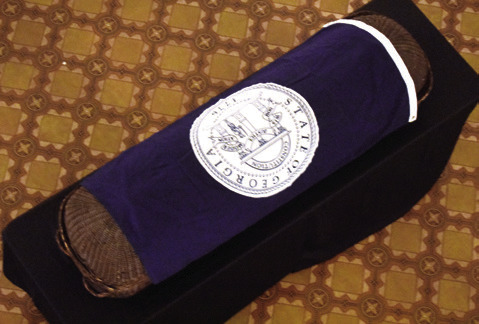
Docents in mourning attire lead three different tours on the chosen night. Guests are taken through the majority of the rooms in the mansion, where everything is dimly lit, mirrors are covered, and in the center of the mansion is a wicker basket coffin, once used for the viewing of Georgia's 59th Gov. Joseph Mackey Brown.
“The rotunda, usually a waiting room for the governor, is set-up for the viewing for a funeral. This particular coffin was used for the viewing of Joseph Mackey Brown,” said the tour guide. “During this time, embalming stemmed from the Civil War when bodies of soldiers were preserved for transport home. We know that Mary Todd Lincoln requested that President Lincoln’s body be embalmed for his body to tour through seven different states and 180 different cities, where people paid their respects to him. Today we know that the United States and Canada embalm most bodies.”
The tour discussed the transition of the death industry from being women-centric to male-dominated, heavily influenced by the profit margin in the industry.
“Ladies had a lot to do with death,” said the tour guide. “So, they were typically nursing the sick. That was looked at as an extension of giving birth, in a way. So, since they could handle that, they could handle the departure of someone.
“For a while, women were really dominating the death market. They were preparing the bodies and basically conducting the duties of funeral directors. Men were doing things like creating the coffins, since they were skilled woodworkers, or transporting the bodies,” the tour guide added. “But, once men realized that the death market was quite profitable, they began taking over these jobs from women.”
Similar to how societal views led women to originally dominate the industry, it also caused different perceptions of mourning based on gender. Women were expected to mourn for two-and-a-half years after losing their husband while men were expected to mourn for only three months upon losing their wife. If a man remarried during his mourning period, his new wife was also expected to mourn.
“The traditional mourning attire for women would start with full black attire but as they moved more into it, they could start adding accents of white lace, and then, in their final stage of mourning, they could welcome deeper, dark colors, like a deep violet,” the tour guide explained. “Men would wear a simple black suit and children were expected to wear black or white based on their age and their relationship to the deceased.”
Societal perceptions also affected the burial practices of the enslaved and overall treatment of enslaved families who lost a loved one.
“We all know that our governors were pro-slavery. It’s said that there were four to seventeen enslaved people living on the property at one time,” said the tour guide. “There are descriptions back then of where plantation owners would take Black bodies and mutilate them to strengthen fear and obedience in the hearts of the other enslaved. African Americans would want to keep vigils throughout the night to honor their dead and some plantation owners thought it disturbed their work, so many times they would have to ask permission to host the vigil.
“It was truly up to the plantation owner what would happen with the Black corpses after they died,” the tour guide added. “Now, many were buried, and it was looked at as a high honor to be buried with the family. However, some plantation owners looked at the death of an enslaved person as the last final chance to make profits. They would sell those cadavers so that they could be experimented on. But, even if they were buried, sometimes this would result in grave robbing. Black graves were disproportionately robbed and disturbed more than white graves during this time period.”
The tour also touched on practices of memorializing the dead, like post-mortem photography, and superstitions, like covering mirrors and stopping clocks at the time of death for the mourning period.
“They believed if someone’s soul was leaving their body and it was looking for its next destination, if it caught itself in a mirror then it would get lost. They also believed that if you looked into a mirror, that you would be the next to go,” said the tour guide pointing to the various black clothes draped over the mirrors.
Tour guides start and end the tour by paying respect to the lives lost during the time period and prompting attendees to remember the different treatment of the dead who were enslaved versus those who were not. It offers a well-rounded perspective of the death industry, societal perceptions, and the different treatment of men versus women and enslaved versus non-enslaved in regard to grief, burial, and memory.
To learn more about Georgia’s Old Governor’s Mansion, visit gcsu.edu/ mansion.