
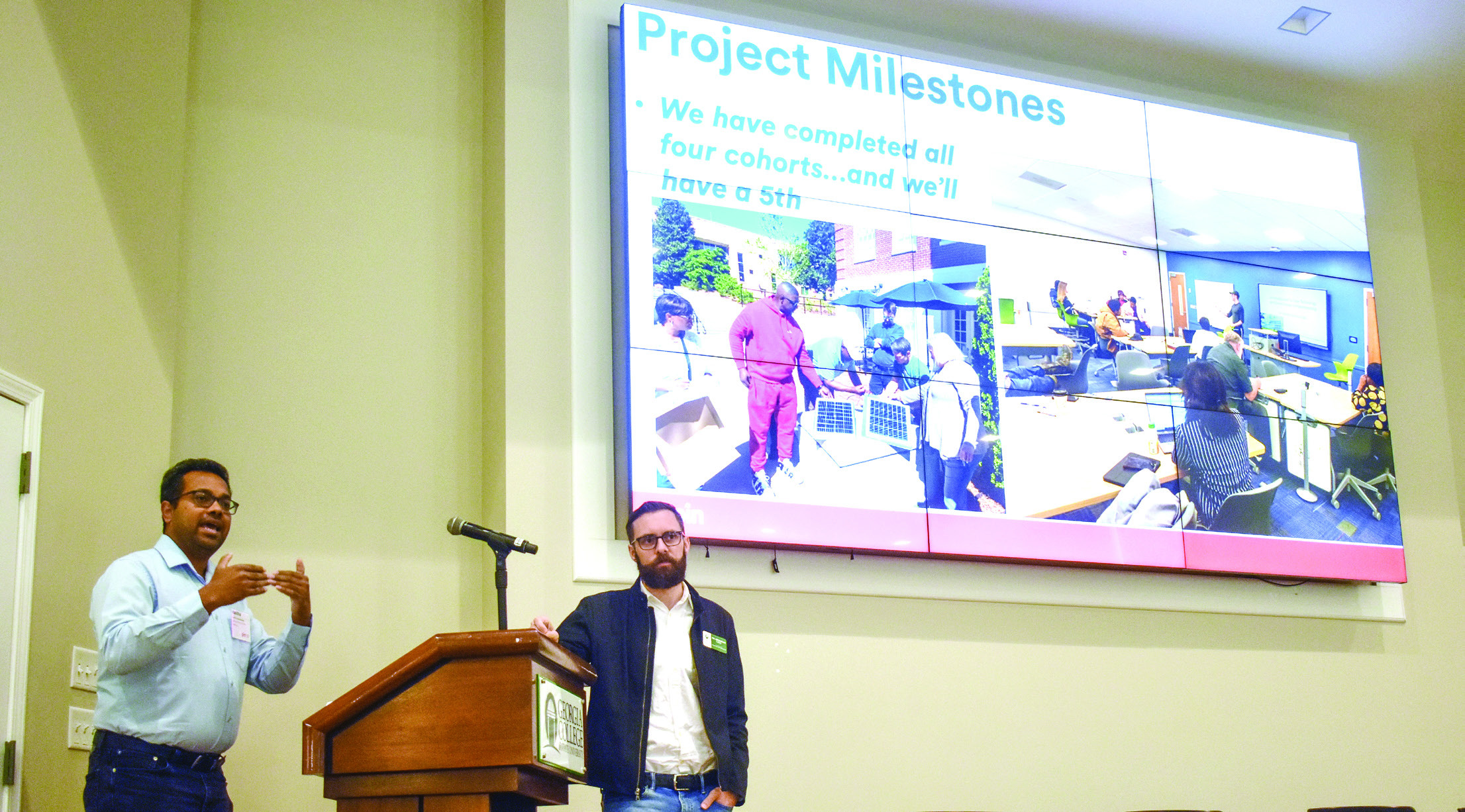
Georgia College & State University hosted the Partnership of Inclusive Innovation’s (PIN) Creative Showcase. At this event, Georgia College and three educational institutions presented an overview of their 2024 projects funded by PIN.
“Each project completed through the Partnership of Inclusive Innovation provides insight and solutions to issues that not only exist in Atlanta, Brunswick, Milledgeville, and Statesboro but across the state,” said Laura Mathis, executive president of the Middle Georgia Regional Commission. “That is one of the reasons we have been a partner since its (PIN’s) inception.
A small number of community members gathered to hear each presentation. Among the crowd was Senator Rick Williams and leaders from the different universities and communities.
The City of Atlanta project presented first with their showcase titled “Accessing Atlanta’s Infrastructure for Equitable Access to Active Transportation and Multimodal Mobility.”
They studied physical infrastructure through activity tracking and air pollution monitoring.
They tracked physical activity during daily activities in the home and outside the home in hopes to determine what modes of transportation may be healthier. Their study is looking at a pre-intervention and post-intervention outlook within a single neighborhood. The study is currently nearing the end of data collection.
The Georgia Southern University Institute for Water and Health (IWH) presented a showcase of their “Safe Water Together Glynn County” completed in Brunswick.
The institute studied the level of water pollution by four superfund pollution sites and its effects on locals who use the water for fishing and crabbing or swimming. Many of the areas affected by the perceived pollution were near low-income communities and affected minority populations.
Seven sites were studied, though there are plans to study more sites in the future. Using Adopt-a-Stream methods to study the water, they determined that the community was being affected by the pollution. Commissioner Allen Booker was one of the participants of the study and spoke in a video about how they came to the conclusion that chemicals were directly affecting his body.
“This grant opportunity builds the capacity of our impunity and empowers traditionally underserved black and brown neighborhoods in our community so that our families can improve their quality of life,” Booker stated.
Following the end of the study, participants and IWH staff installed a mini water quality lab complete with water analysis kits, reagents, and equipment necessary and gave this lab to the community.
The Georgia Southern University Collaborative Project presented a “Proof of Concept study for an Indoor Quality Intervention in the Workplace of Public Historical Buildings in downtown Statesboro.” They studied the air quality in 16 buildings and compared it based on a pre-intervention, mid-intervention, and post-intervention analysis. The intervention completed was using plant-based intervention over approximately two months. Their study concluded that green plants can effectively reduce levels of malodor and selected VOCs.
Participants also reported an overall increased perception of air quality.
Concluding the 2024 reports, Georgia College & State University reported its solar project with the city of Milledgeville. GCSU offered a free certificate course blending business and solar physics to provide $20,000 worth of solar panels to Baldwin County’s Water Treatment Facility. The goal was to provide a course that taught about solar technology and entrepreneurship to teach participants not only how to work and install solar panels but to create and manage their own companies. According to Director of the Center for Innovation and Entrepreneurship Nicholas Creel, three of the 40 people who participated are looking to start their own company.
“That’s a pretty high success rate … we are studying a return of investments. When you put it in, what will you get out of it in the long term?” said Creel.
Georgia College announced that it plans to host a fifth cohort of 10 people with leftover funds. There are also plans to expand past solar panels using funding from the National Science Foundation to expand workforce development activities.
“This provides $400,00 over three years to expand innovative partnerships with industry in Georgia, particularly the green technology industry,” stated their presentation. Closing the showcase, PIN Community Research Manager Katie O’Connor announced the winners of the 2025 funding which included the City of Millen, Forsyth County, Charleston County, S.C. and Chatham County, Ga. together, and Easement, Ga. and Marion, Ala. together.