
>> BALDWIN COUNTY SCHOOLS
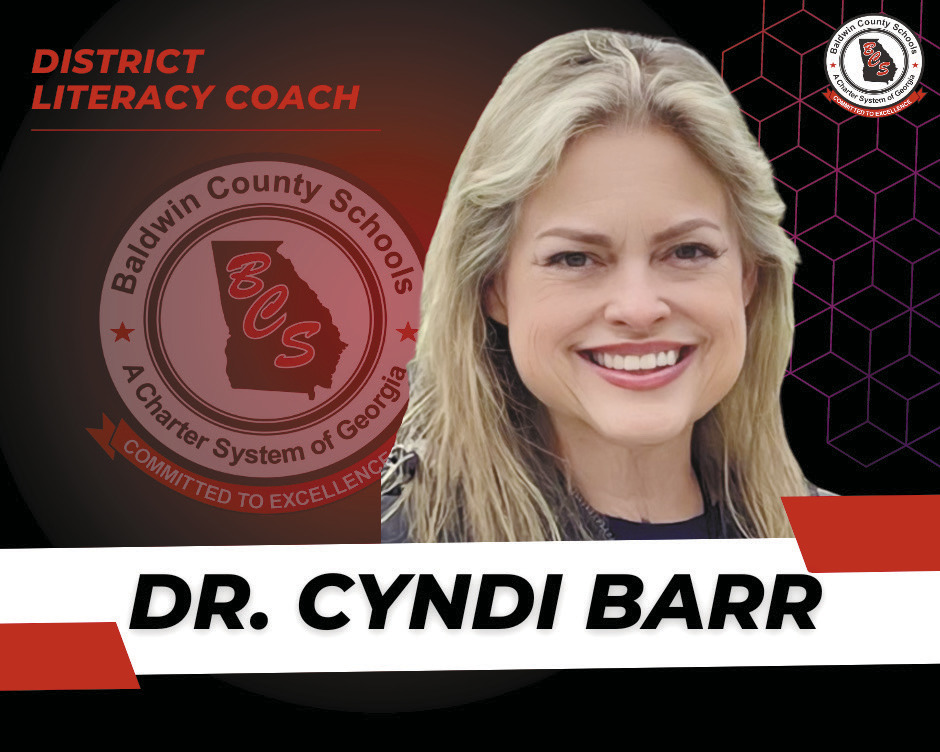
Previously, the Baldwin County School District (BCSD) was developing a curriculum through a literacy consultant but to provide more emphasis on literacy instruction, the district created a literacy coach position. At the end of July, BCSD appointed Dr. Cyndi Barr as the district’s new literacy coach.
Barr has multiple degrees and endorsements that qualify her for the position. She received her bachelor’s degree in General Studies from The University of Maryland College Park and a master’s degree in Curriculum Instruction and Reading from Grand Canyon University.
Additionally, Barr received her specialist degree in teacher leadership from Georgia College & State University, which makes her familiar with Milledgeville, and received her doctorate in Leadership and Professional Practices from Trevecca Nazarene University.
She also earned her Tier I leadership certification from West Georgia University and her Tier II leadership certification from Valdosta State University. Barr has also completed the following endorsements including gifted, reading, English as a second language, multitiered system of supports, special education, online instruction, instructional coach, and personalized learning.
“I’m very excited to take my expertise and get inside the classroom with teachers to provide model lessons and do professional learning. I have an entire arsenal of learning strategies that I’ve used over the years,” said Barr. “Working closely with teachers has always been very important to me throughout my educational career.”
Barr has 16 years of experience in the education field. Her career began in Clark County and spanned many positions including classroom teacher, teacher leader, mentor teacher, online teacher, department chair, and instructional coach.
According to Barr, she had a connection with Superintendent Dr. Noris Price and heard about their initiatives in education and background in English Language Arts, which inspired her to apply for the position in Baldwin County.
“I watched Dr. Price’s career over the years, and I am very supportive of her literacy initiatives, so I jumped on the opportunity to work with them and am very excited to work with her,” said Barr. “I will be meeting with Price during the school year to discuss her initiatives and how we can improve literacy within the county.”
As a literacy coach, Barr’s duties include developing strategies, embedding effective strategies into the schools, studying data, coordinating interventions, working side by side with teachers in the classroom, and more. Her position spans kindergarten through 12th grade, so she will be involved with all schools in the district.
“My goals for the upcoming school year are to increase literacy and writing in every content area and to bring Dr. Price’s reading strategies and initiatives to life,” said Barr. “I plan to work closely with the curriculum instruction team to support our instructional leaders and do whatever we can to get these literacy initiatives going.”
According to Barr, she is pursuing the same quote as Price believes in, “Readers are leaders. Leaders are readers.” Barr believes that building literacy skills is intertwined with making an enriching space to learn and creating an atmosphere that makes students desire to read and write, rather than falling into stigmas around these actions.
“When I entered the education field, I learned a lot about student engagement and bringing fun into the classroom. So, I applied that to my classroom. For example, one day my students came into a surgery center rather than a classroom and they were using forceps to form sentences and learn grammar,” said Barr. “They were excited, which made them invested. By being invested, they were going home and discussing how much fun they were having and taking these lessons home.”
According to Barr, she became a teacher leader and mentor in Clarke County and was able to help apply reading to all subjects.
She believes this experience prepares her the most to work with Baldwin County teachers in and out of the classroom to engage students and apply literacy to every subject.
“People think reading is a chore and writing is seen as a punishment. This association prevents students from wanting to improve their literacy skills and that is why engaging them is so important to break these associations,” said Barr. “They are not only important life skills but something that students should find active enjoyment in.”