
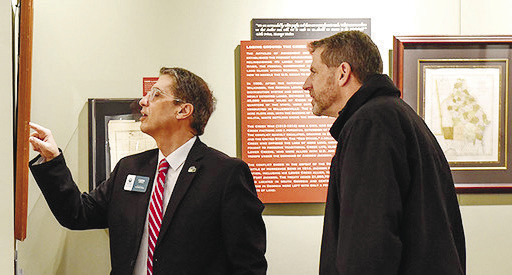
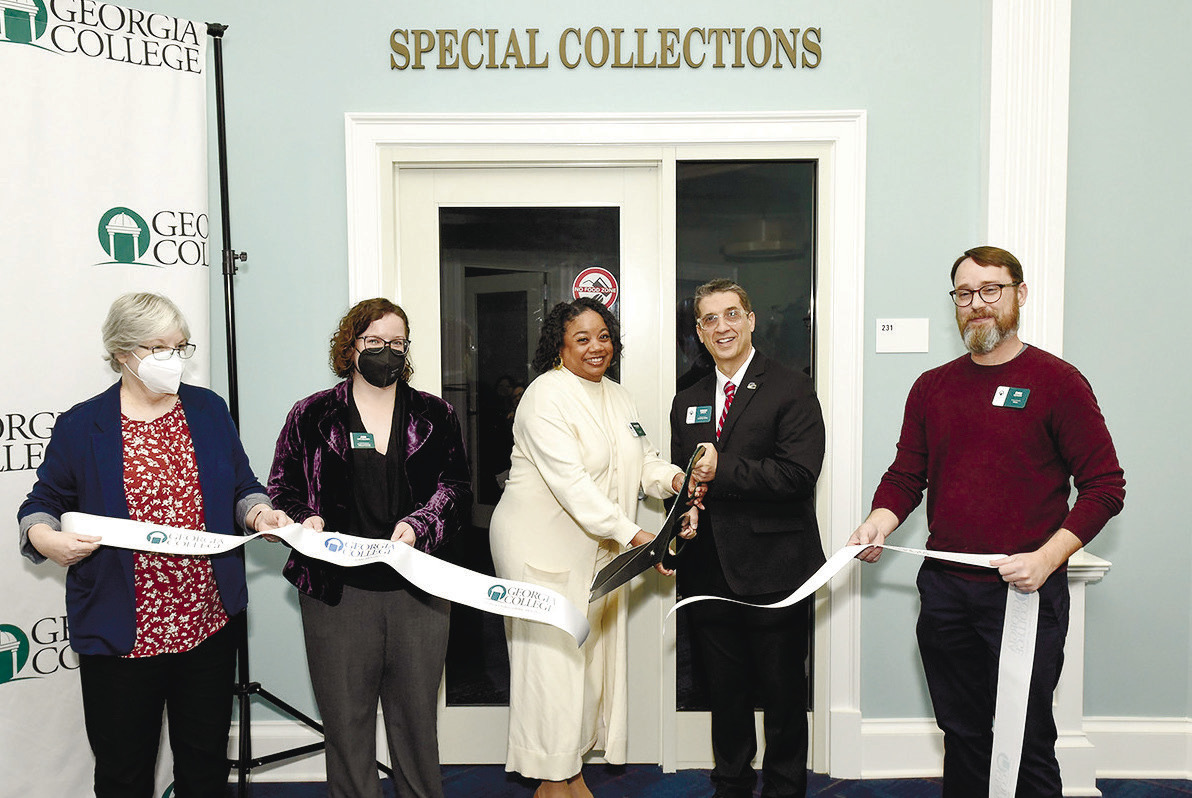
Georgia College & State University celebrated the expansion of Special Collections and the official opening of the Rare Book Room on Feb. 13.
Special Collections & Galleries began as the Georgia Room. Former GCSU president Dr. J.
Luther Beeson’s wife, Leola Beeson, was an amateur historian and wrote an initial history of Milledgeville and Baldwin County. The Georgia Room was started with the writings of Beeson and artifacts and other items that were given to her as she researched and recorded the history. Then, in the 1940s, professor of history and southern writer Dr.
James C. Bonner wrote the academic history of Milledgeville. During his research, people also donated items that were added to the Georgia Room. Though it would not be until 1981 that the official Special Collections & Galleries would be created.
“It would not be until 1981 that we had a designated area to preserve and display those materials,” said Nancy Bray, associate director for Special Collections. “Before that time, everything was just collected from what was donated and we stored everything in what was called the Georgia Room, because it housed items that preserved Georgia’s history.”
Today, Special Collections & Galleriaes resides in the Ina Dillard Russell Library at Georgia College. It documents the history of Milledgeville and Baldwin County and surrounding counties. Special Collections currently hosts University Archives, Digital Collections, Public Services, Rare Books and Manuscripts, and the Special Collections Galleries which are located in Heritage Hall.
“We’ve got very old and fairly new history preserved in Special Collections,” said Bray.
“What has been collected over the years has been very quaint and over the years we have been trying to expand our collections to be more inclusive and reflective of our community. For example, former mayor of Milledgeville Floyd Griffin was the first African American to donate his collection so we have his military, legislative, mayoral and more items now within Special Collections.”
The expansion of Special Collections, according to Bray, was highly anticipated and needed to pursue this goal. With this expansion new digital humanities and oral history labs, an expanded room for archival research, a larger work area for library staff and the Rare Book Room have been added to Special Collections.
“This expansion offers more opportunities for not only students and faculty to add to collections but our local community,” said Bray.
“I encourage people to bring items to donate, to come see our collections, and share their own history so we can have an inclusive and expansive history of Baldwin County and surrounding communities.”
The oral history and digital humanities labs were installed to offer the community and GCSU staff and students a chance to add directly to the collection.The oral history lab allows individuals to record interviews with audio and video equipment. The digital humanities lab allows individuals to collaborate on projects that use digital tools to analyze information and process data.
Both labs will allow the GCSU and local community to better preserve and process historical data.
“In 2012 and 2013, we began to have the conversations of expansion with former Provost Dr.
Kelly Brown and former Assistant Provost (now provost) Dr. Costas Spiro.
So this is the fruition of all that planning to ensure that we could have a differentiation in space for storage and public display,” said Bray. “Then, the Rare Book Room was an idea that would allow administration to bring VIPs, potential donors, the public and more to see a condensed view of the treasures from special collections while Heritage Hall offers a more expansive view.”
The Rare Book Room was the dream of former president Dr. Steve Doorman, although it was not constructed until after his retirement. The room is created to show off smaller and more precise exhibits. The highlight of the ribbon-cutting ceremony was the premier of its first two exhibits: “To Be Uninvited Guests” and “The Faces of Flannery O’Connor.” “To Be Uninvited Guests” features artifacts from Thomas and Janice Armstrong’s Antique Map Collection while “The Faces of Flannery O’Connor” shows off more materias in the university’s collection related to famous author Flannery O’Connor that are not present at Andalusia Farm.
“We are so happy to have this expansion and to officially open the Rare Book Room,” said Bray.
“We hope to continue adding to our collections and watching it fill all this new space.”
Special Collections and the Rare Book Room are open to the public.
Appointments are highly recommended when visiting to ensure staff can pull any necessary materials and offer a more specific look at history of a viewer’s interest. The research room is open Monday through Friday 9 a.m. to noon and 1-4 p.m. during fall and spring semesters. Heritage Hall and the galleries are open 9 a.m. to 5 p.m. To make an appointment or inquire about collections, please call 478-445-0988.