

Georgia College received a bronze plaque and certificate from the National Park Service (NPS) this past Monday officially designating Andalusia Farm, the historic home of author Flannery O’Connor, as a national historic landmark.
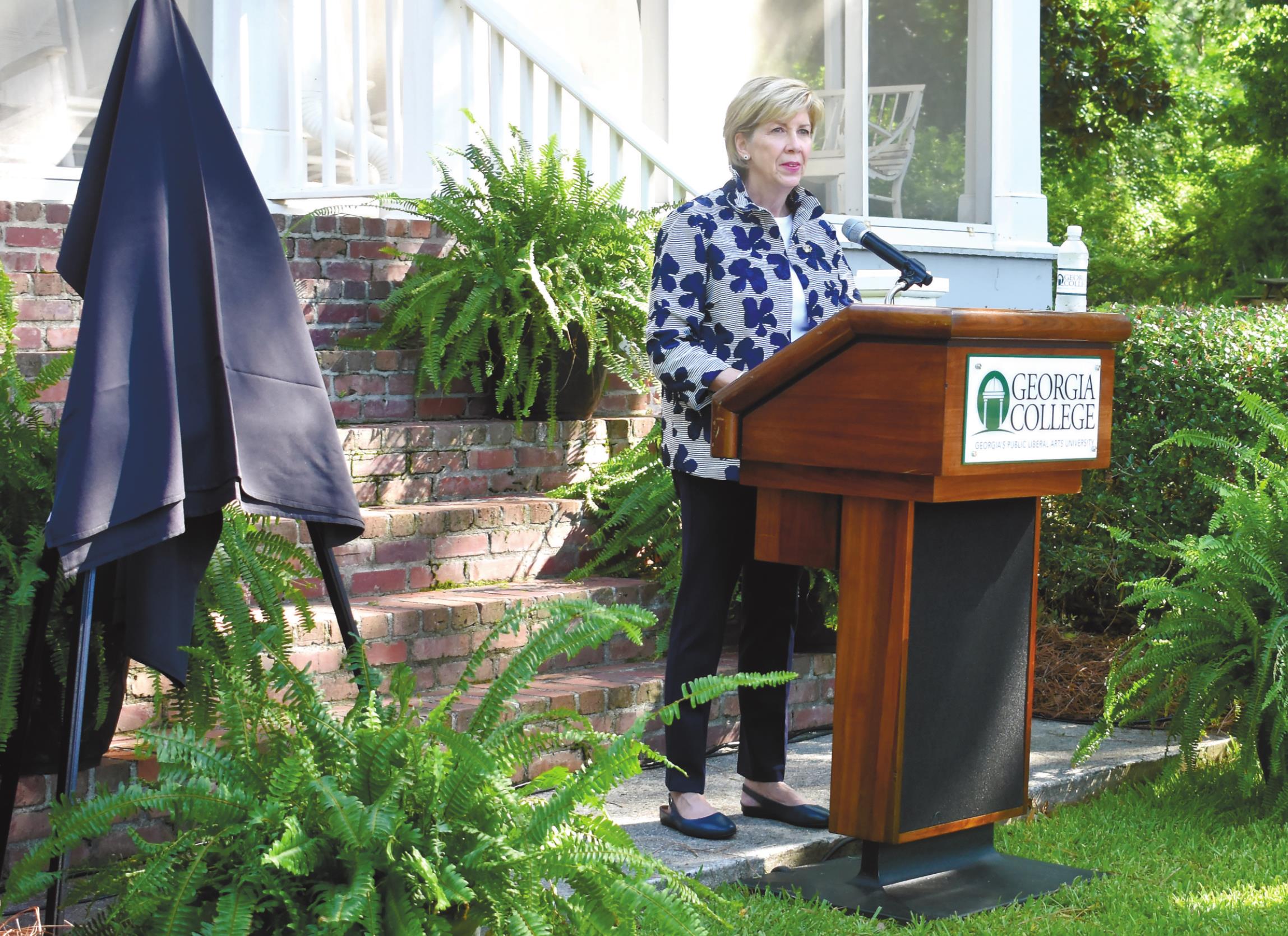
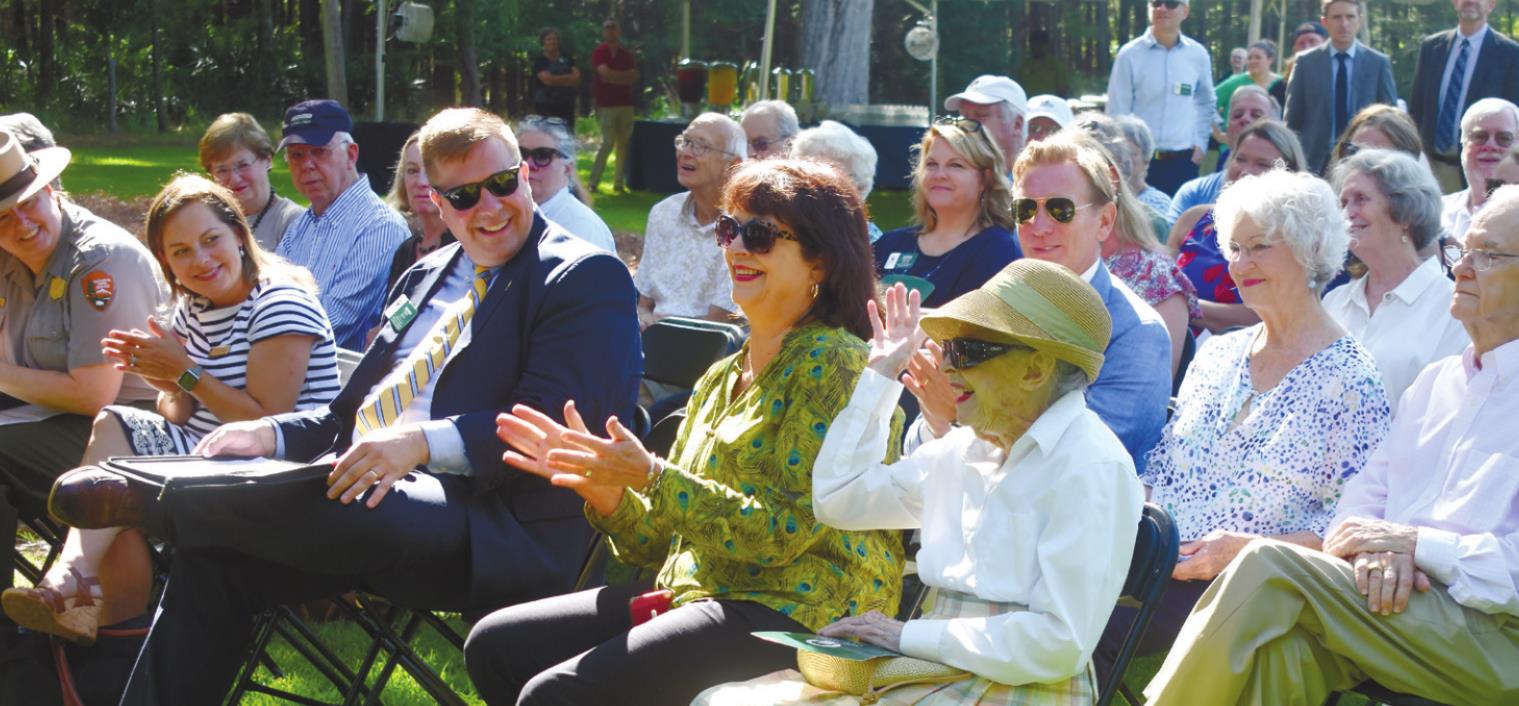
After being announced in February, Andalusia’s designation was celebrated with a large turnout of supporters on the farmhouse lawn. College President Cathy Cox, Director of Historic Museums Matthew Davis, members of the national and southeastern offices of the National Park Service, and trustee of the Mary Flannery O’Connor Charitable Trust and a member of the O’Connor family, Louise Florencourt, were all in attendance. The plaque was awarded to Cox and Davis by Carla Beasley, superintendent of Ocmulgee Mounds National Historic Park, in Macon.
“As many of you know, national historic landmarks are nationally significant historic places that have exceptional abilities to illustrate and interpret America’s cultural heritage,” Cox told the crowd on hand. “And by that definition it is easy to understand why Andalusia has received this designation. The farmhouse behind me and the farm property of Flannery O’Connor inspired one of America’s most iconic writers.”
Andalusia Farm is the second designated historic landmark owned by Georgia College, with the first being Georgia’s Old Governor’s Mansion. According to Davis, fewer than three percent of historical sites in the U.S. bear a national historic landmark designation, so it is extraordinary and rare for Georgia College to own two.
“The fact that Georgia College is the proud steward of two of these properties is something that we as a campus can be proud of,” said Davis. “Our students … and the community can be proud because this will bring visitors from all over the world that want to learn about these properties that are truly significant.”
O’Connor was most famous for her work in short stories. From 1951 to 1964, Andalusia Farm, just north of Milledgeville, served as her home, where she completed the bulk of her literary work. The farm’s environment influenced the setting of many of her writings and farm life gave her enrichment as lupus slowly stole away her youth. In addition, O’Connor was a 1945 alumna of Georgia College, then known as Georgia State College for Women.
“This designation of the national landmark was a slow process and it’s been over a decade’s worth of work to get to this point,” said Davis. “And we continue to appreciate the Flannery O’Connor Foundation through its stewardship of the property and its gift of Andalusia, along with all its properties, collections and remaining resources to the Georgia College Foundation, so that we could continue to preserve, protect and extend the value of this site.”
Previously, Andalusia was listed in 1980 on the National Register of Historic Places, and in 2019 it was named a distinctive destination by the National Trust for Historic Preservation. Now an official national historic landmark, Davis said the title will help with future acquisitions, grant applications, and the continued restoration of the inside of the farmhouse.
“As many of you may have seen as you drove in, our next project for this site is under construction. The interpretive center is being built and will enable us to properly introduce visitors to the creative genius of Flannery O’Connor and to the special farm property. The interpretive center will have plenty of exhibit and meeting space and proper restroom facilities,” said Cox, who added the center is expected to open by next spring.