
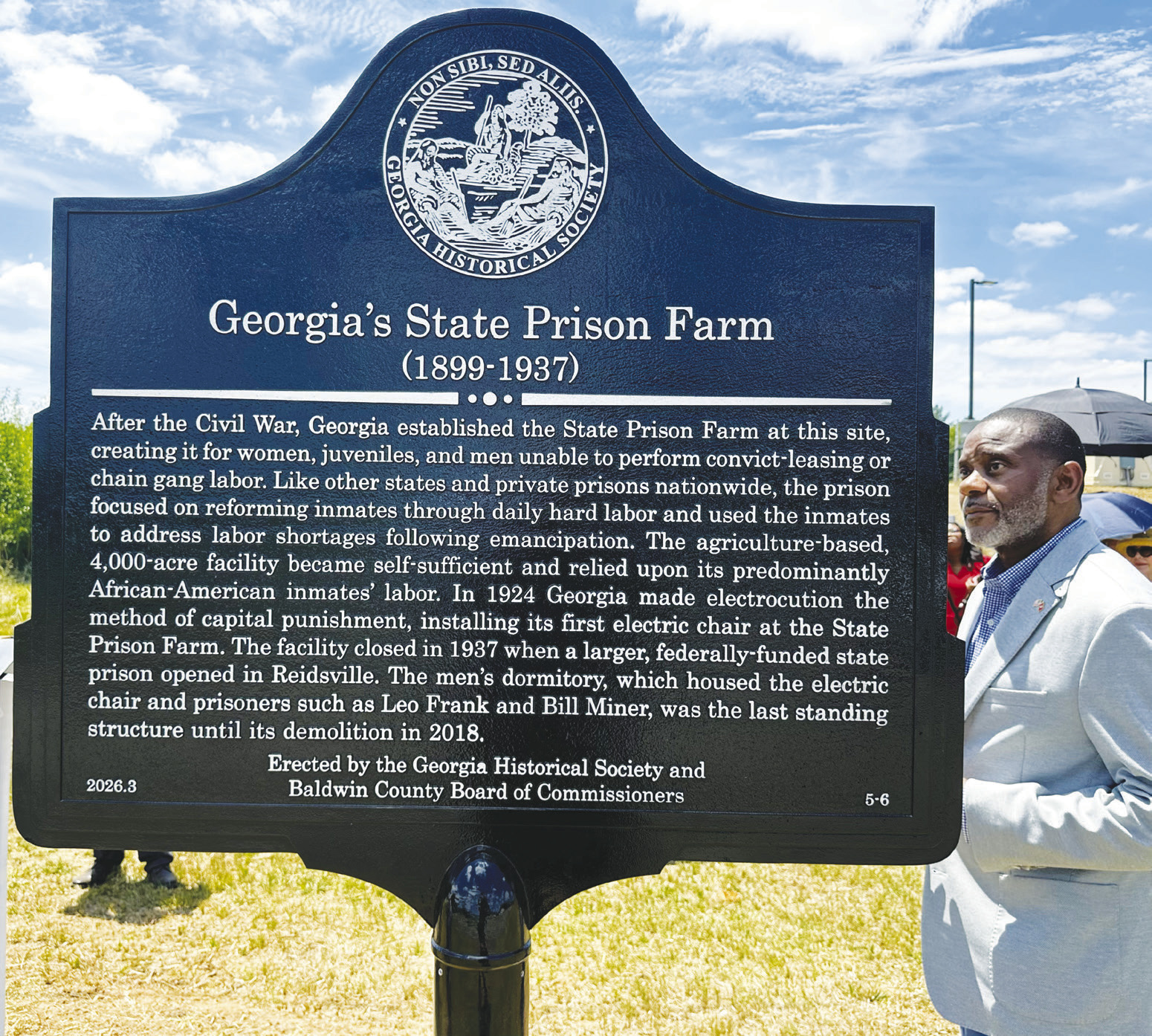
Milledgeville is one of the most historically significant cities in Georgia, so it only makes sense that Baldwin County is home to more than two dozen Georgia Historical Society markers.
The latest marker – Georgia’s State Prison Farm – was unveiled during a ceremony at Walter B. Williams Jr.
Park on Tuesday. The marker is located roughly 20 yards away from the new Splash Baldwin waterpark. While the ceremony was taking place, several county employees were testing the splash pads at the waterpark. The Prison Farm building, or what was left of it, was demolished last year to make way for the waterpark.
Reads the marker: “After the Civil War, Georgia established the State Prison Farm at this site, creating it for women, juveniles, and men unable to perform convict-leasing or chain gang labor.
Like other states and private prisons nationwide, the prison focused on reforming inmates through daily hard labor and used the inmates to address labor shortages following emancipation.
The agriculture-based, 4,000-acre facility became self-sufficient and relied upon its predominantly African-American inmates’ labor. In 1924 Georgia made electrocution the method of capital punishment, installing its first electric chair at the State Prison Farm.
The facility closed in 1937 when a larger, federally- funded state prison opened in Reidsville. The men’s dormitory, which housed the electric chair and prisoners such as Leo Frank and Bill Miner, was the last standing structure until its demolition in 2018.”
Edwin Atkins, a Macon man, spearheaded the effort for the creation the new marker. Atkins’ grandfather was the chaplain at the Prison Farm for a number of years.
Atkins has been a staunch opponent of the new waterpark. He and former County Manager Carlos Tobar got in a back-inforth in the media several years ago about whether or not the waterpark sits atop human remains.
Tobar always disputed Atkins’ claim, pointing out that the new water park would be located exactly where the old state prison building once stood. How could you bury prisoners underneath a brick building, or why would you bury prisoners right beside a building, according to Tobar.
At the time, Tobar added that the county government had “received environmental clearance and the go-ahead from the (Georgia) Department of Community Affairs.”
“There was a big historical building condition assessment report that was commissioned.
There’s no indication in (the report) that there’s anything there,” said Tobar, with the “there” meaning human remains. At the old 4,000-acre Prison Farm property, there existed a “white cemetery” and a “black cemetery.” The location of the black cemetery has been known for many years and is well-documented, and it’s located roughly a half-mile from the old prison building and closer to Ga. 212 and the new Walter B. soccer fields. According to The Georgia Trust, the “Red Hill Prison Cemetery” is situated “on a hill overlooking the 4,000-acre Old State Prison Farm in Milledgeville...Red Hill Prison Cemetery is home to over 600 graves of incarcerated men and women who died at the prison between 1911 and 1936. License plates manufactured on site by the prisoners were used as grave markers for the deceased prisoners, indicating each grave by number, not name.
Once the prison closed and moved locations in 1937, these graves were left unattended and neglected.”
As for the “white cemetery,” well, the “white cemetery” has never been found. Atkins believes there’s a possibility that the white prisoners were buried underneath the water park site.