
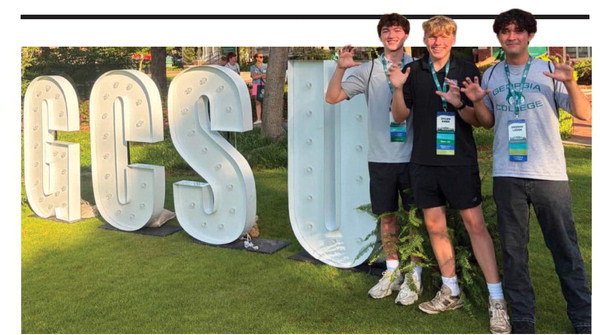


Downtown Milledgeville once again is awake, its annual summer snooze over, as classes resumed this week at Georgia College & State University.
Right around 1,850 freshmen are enrolled this semester, setting the school record, one that dates back 135 years. Fulton is the county most represented among the freshman class, followed in order by Forsyth, Cobb, Gwinnett and Dekalb. For several decades, Gwinnett was always the leader in the clubhouse. That streak was broken in 2008, when Fulton took the top spot. In the late ‘90s, GCSU recruiters began more aggressively recruiting north Fulton and Cobb, while putting fewer resources into recruiting Gwinnett. Later came Forsyth County, which has grown from a Census population of 44,083 in 2000 (about the same as Baldwin County) to 282,905 in 2025 (nearly as big as Bibb and Houston counties, combined).
In recent years, at least, 70-something percent of GCSU students have hailed from the 29-county Atlanta Metropolitan Statistical Area.
GCSU’s transition from “commuter college” to “smart college” has been complete for a number of years now. The average ACT score for this year’s incoming freshmen was 25, while the average SAT score was 1178. The Class of 2030’s average high school GPA, meanwhile, was 3.8. GCSU is one of the three “most qualified” colleges and universities in the 25-member University System of Georgia, trailing only Georgia Tech and the University of Georgia, according to Amanda Respess, GCSU’s director of news & media relations.
“We remain one of the state’s three ‘selective’ institutions, along with Georgia Tech and UGA. The top three schools set more rigorous admissions criteria, and they rank number 1, 2 and 3 for the most academically qualified students, in terms of their entering GPAs and test scores,” she said.
Two events set GCSU up to become a “smart college.” First was the HOPE Scholarship in 1993, which made the parents of high-achieving high schoolers in Georgia think twice before sending their kids off to out-of-state colleges. Then came the big one, when the Board of Regents officially named GCSU as “Georgia’s designated public liberal arts institution.” This meant more resources and more backing from the Board of Regents. That was in 1996, the same year that “& State University” was added after “Georgia College.”
The new designation allowed GCSU to hire more talented faculty and lower its class sizes. Thirty years later, the 17:1 class size ratio is perhaps the university’s biggest calling card. More than 10,000 high school seniors applied to GCSU during the most recent cycle, the most ever.
In other words, GCSU is on a roll.