

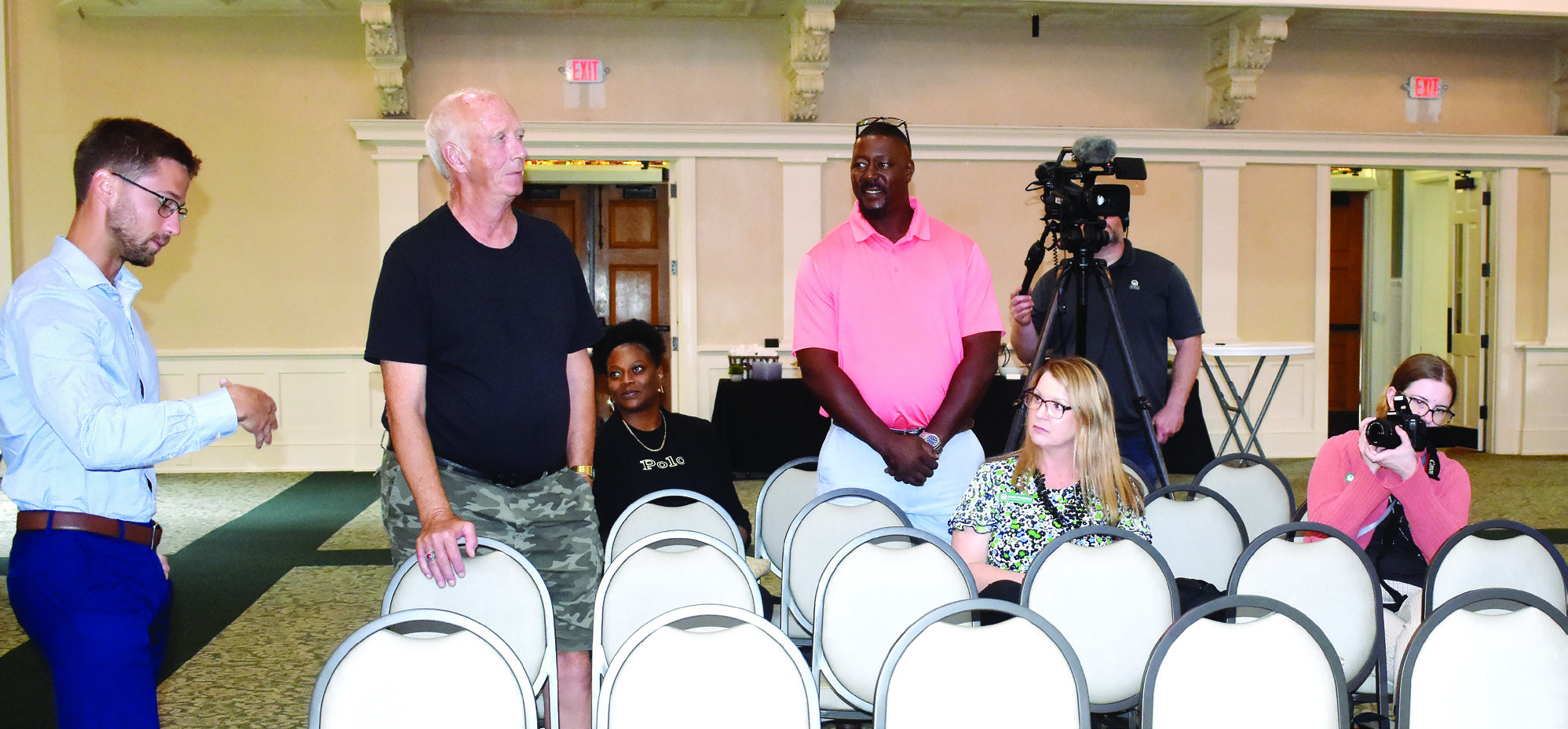
Georgia College & State University (GCSU) celebrated the completion of its solar project with the city of Milledgeville July 29 in its Magnolia Ballroom.
Last September, it was announced that GCSU and the city received a $100,000 grant to educate community members on the design and installation of solar panels. The funding came through the Partnership for Inclusive Innovation (PII), which promotes community projects to enhance economic development. Through this funding GCSU offered a free certificate course blending business and solar physics to provide $20,000 worth of solar panels to Baldwin County’s water treatment facility.
The 48-hour course was taught in four cohorts with 10 members in each cohort. Ten of those residents who took classes last spring were selected to install 38 solar panels on July 27 at the Lamar F. Hamm Water Treatment Plant at 510 E. Montgomery St. in Milledgeville.
“Similar courses are estimated to be about $1,500 and at least three hours away from the central Georgia area,” said Director of the Center for Innovation and Entrepreneurship Nicholas Creel during the introduction of the presentation.
According to Creel, the course was created to combat economic hardships, create a targeted workforce, and connect with the environment. The course was a pilot program and GCSU is currently building a feasibility report based on the program to be able to scale the it across the southeastern United States.
During the course, professors focused on direct personal connections, observing participant’s change in attitude toward green energy. They are currently studying the macroeconomic effect this course and its solar panel installation are having on the local economy.
“Students were learning from doing and from listening to industry professionals. We had a large willingness from area officials to be a part of the course,” said Creel.
Four of the solar installers were present at the ceremony. Ryan Agnew is an alumnus of GCSU and was the solar panel partner. He donated the solar panels that were installed. Mark Sullivan is a local retired bus driver who was interested in the course after hearing about it. Melanie Byas was interested in learning about solar energy and learned the most from installing the panels. Travaris Veal is another GCSU alumni and works in utilities. Taking the class was a chance for him to advance his education and expand his interest in the energy sector.
“Many of the participants who took the class were doing so to upscale,” said Creel. “Upscaling allows them to get better pay and better flexibility with their jobs, and another goal for this program was to offer them the education to be able to do that.”
Dr. Hasitha Mahabaduge, associate professor of physics and an instructor of the program, presented pictures of the installation and spoke about the takeaways of the program. He explained that doing the program for free was likely not the best way to do it and in the future using paperwork or the cost of the exam may be a good buffer to filter those committed to the program from others just applying with little interest. Out of the teaching schedule, they also concluded that the Saturday-only model was ideal over a weeknight schedule.
However, Mahabaduge concluded the program was overall successful and positively impacted both its students and the community.
“They installed a fullsized solar array,” said Creel. Mahabaduge added, “Annual energy production will be about 20 megawatt hours. The maximum achieved power per day will be about 10 kilowatts, which takes about 15 to 30 per day for a typical house. They can use the solar power without interrupting the facility’s normal operations.”
Moving forward, GCSU is now in stage 2 of a National Science Foundation grant that could expand workforce development activities like this project. They anticipate a funding decision by this fall. In addition, Milledgeville City Manager Hank Griffeth noted at the end of the presentation that the city is looking for more green opportunities and that the installation area was a good place to start, but there is a lot more area to expand “down the road.”