
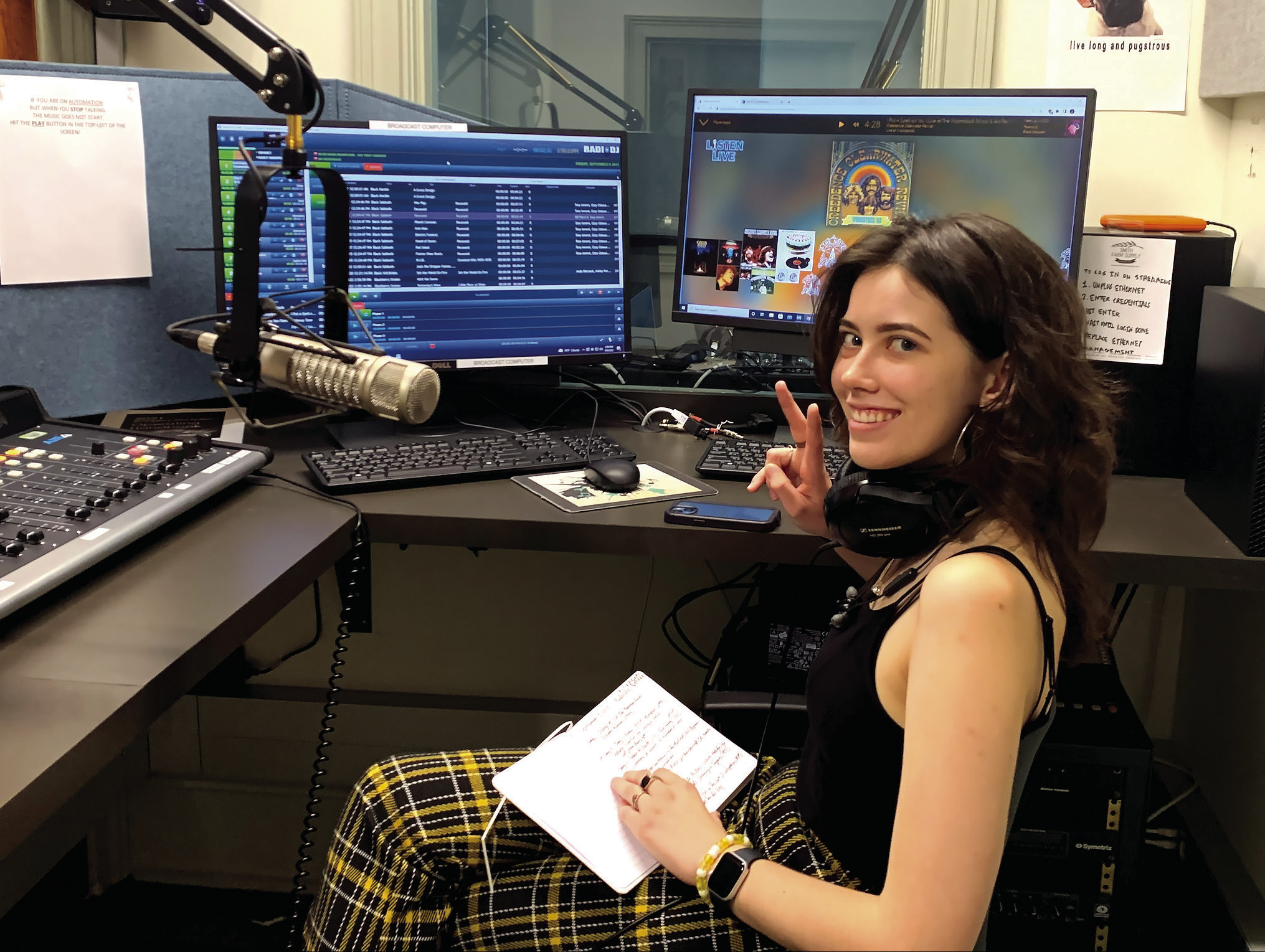
Georgia College & State University is celebrating the 50th anniversary of its student radio WGUR and the 100th anniversary of the school newspaper, The Colonnade, on Oct. 17 with current students and alumni.
Former Faculty Advisor Angela Criscoe worked with the radio station from 2007 through 2016, advising students, keeping up with Federal Communication Commission guidelines, and helping the radio station transform.
“Georgia College has two radio stations. WGUR is the student broadcasting station where students can produce their own radio shows and WRGC is Georgia College’s professional station partnered with Georgia Public Broadcasting,” said Criscoe.
WGUR has about a 10-mile radius reach while WRGC has about a 60-mile radius reach. WGUR is categorized as an educational non-commercial station and is used as a teaching ground for students of all majors to learn about media broadcasting, leadership, radio conduct, and more.
“It is a playground where students can learn about federal guidelines while sharing a piece of themselves with our community,” said Criscoe. “While I am not the advisor anymore, I continue to promote the station to students because it is a genuinely unique educational experience.”
WGUR General Manager Kellen O’Neil started as a show host during her freshman year. Her show focused on music, covering pop culture, playing her favorite bands, offering music trivia, and more.
“When I was looking for a college to apply to, I wanted a college with an active radio station. Music is a passion of mine, and I wanted the opportunity to explore that,” said O’Neil. “My first show could have been improved a lot. It was a learning experience that taught me a lot about sound, radio ethics, how to navigate a topic, the importance of choosing a song, how to connect with my audience, and more. It was the steppingstone that led me to become WGUR program director last year and general manager this year.”
O’Neil’s role with WGUR transformed from being directly on the air to working with all the radio show hosts to plan content, schedule the shows, guide students, and more.
“It has taught me a lot about teamwork and how to connect a range of topics to create a cohesive system that people will enjoy,” said O’Neil. “A show is powerful alone, but a station is at its best when shows can work together and build a community. I’ve learned a lot about management, advising, and many other things that I think are essential to any future profession.”
According to Faculty Advisor Eva Galova-Iossifov, radio shows are each about an hour. Students go through training to understand federal regulations and guidelines, how to work the technology, how to speak and write scripts, and are offered refresher courses throughout the year.
“The station is not just open to students but staff, faculty, and the community. We welcome anyone who is interested in radio to reach out and we can discuss the type of show they would like to broadcast,” said Galova-Iossifov. “Radio is one of two mainstream medias anyone can access. It is also one of the only localized media and is one of the most efficient media during an emergency. So, it is a very special form of media for students to learn and be involved in.”
The second mainstream media anyone can access is the newspaper. For GCSU, The Colonnade is its print form of communication allowing students to work as journalists, graphic designers, sports reporters, and editors. GCSU alum Flannery O’Connor even worked on The Colonnade as a graphic designer during her time as a student.
“I’ve always been interested in publishing so when I heard about The Colonnade, I decided to apply for a position. I was hired on as the assistant editor for Arts and Life and was recently promoted to editor-inchief,” said Editor-in-Chief Mary Ciucevich.
Ciucevich is a senior English major and began working on the newspaper during her junior year. She applied for the Arts and Life section of the newspaper feeling it was “better suited” for her due to her involvement with many organizations on campus.
“ The Colonnade is very special to me. While it may be a different style of writing than what I use in my major, it has expanded how I seek ideas and approach topics,” said Ciucevich. “It’s a new extension of writing for me.”
As the editor-in-chief, Ciucevich has learned about new writing styles, understanding others’ writing and voices, delegating and mentoring, and how positions, deadlines, and ideas impact workflow and the final product.
“I’ve been introduced to so many new experiences and events through my work in the newspaper,” Ciucevich said. “It will be one of the most memorable experiences of my college career after I graduate in May.”
The anniversaries of both media outlets will be celebrated Oct. 17 with a tour of production rooms and a networking event afterwards. WGUR will be inviting alumni to speak on the radio in celebration of the anniversary with other plans also being discussed. The Colonnade can be read online at bobcatmultimedia. com/category/thecolonnade/ and WGUR may be listened to on the GCSU WGUR Radio App or by visiting gcsuradio.com.